For decades, search worked through blue links. You typed a query into Google, got a list of websites, and clicked the one that clicked with you.
Buyers today start somewhere else.
They ask AI assistants like Google’s AI Overview, ChatGPT, Gemini, or Perplexity for product recommendations and comparisons.
Only instead of links, these systems generate answers.
That means brands now need to optimize for a new layer of visibility. Not just to rank on Google, but to be understood and cited by AI systems.
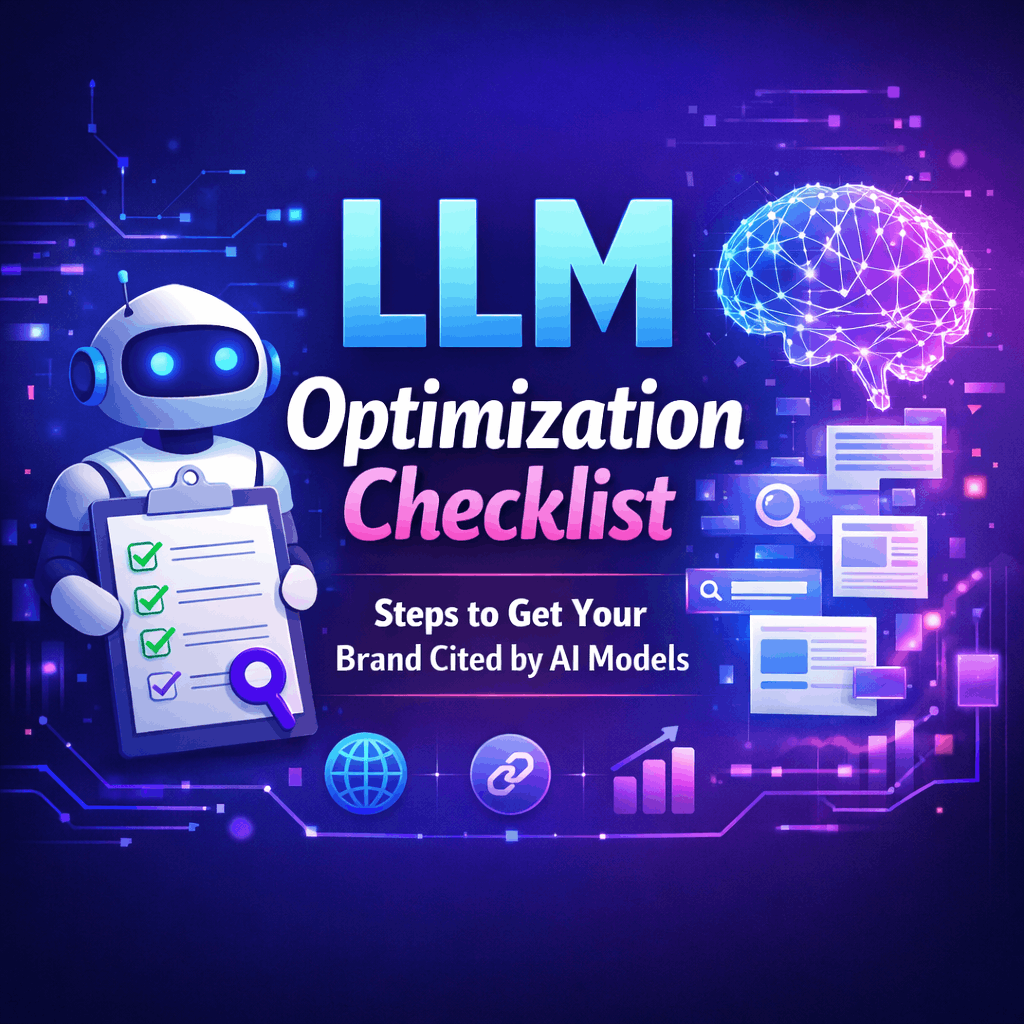
The LLM optimization checklist in this guide shows you how to do exactly that.
We’ve seen time and time again that most cited brands are not the ones shouting loudest. They’re the ones with the highest trust signals.
Want to see how your brand currently appears in AI-generated answers? Schedule a free demo with Sorn.ai and we’ll show you exactly where you stand.
What Is an LLM Optimization Checklist and Why Does It Matter for SEO in 2026?
An LLM optimization checklist is a structured framework for making your website easier for AI systems to discover, understand and cite.
Look at it this way:
Traditional SEO focuses on ranking webpages in search results. LLM optimization focuses on helping your brand appear inside AI-generated answers.
This shift matters because search behavior is changing. Fast.
Google’s AI-generated summaries now reach more than 1.5 billion users every month, making them one of the largest AI search surfaces in the world.
At the same time, large-scale search studies show that AI summaries now appear on roughly 20 percent of Google searches. The percentages are even higher for longer, question-based queries.
When these summaries appear, they often answer the question directly on the search results page. Call it a zero-click policy.
This. Changes. Everything.
Research measuring click-through rates shows that the presence of an AI overview can reduce organic click-through rates by around 34 percent on average.
Other analyses have observed even larger drops for certain queries. Studies report declines of 50–60 percent in organic traffic when AI summaries dominate the page.
This means a website can rank highly in Google but still receive fewer visits because the answer has already been generated above the results.
That is why brands now need LLM optimization to survive.
Instead of competing for rankings, we all now compete to be cited as trusted sources inside AI-generated answers.
Comparison Table: Traditional SEO vs LLM Optimization
| Factor | Traditional SEO | LLM Optimization |
| Primary goal | Rank on search results pages | Get cited in AI-generated answers |
| Key signals | Backlinks, keyword targeting | Entity authority, semantic clarity, structured data |
| Content format | Long-form keyword pages | Concise, fact-dense sections |
| Discovery method | Crawling and indexing | Retrieval and semantic matching |
| User interaction | Click to website | Answer delivered directly in chat |
| Conversion path | Landing page funnel | Brand mention → branded search → conversion |
How Does Traditional SEO Differ From Answer Engine and Generative Engine Optimization?
Search marketing now includes three overlapping strategies.
SEO (Search Engine Optimization)
SEO focuses on ranking pages within search engine results pages. The goal is to increase visibility and drive traffic from organic search.
AEO (Answer Engine Optimization)
AEO focuses on appearing in direct answer formats, including:
- Featured snippets
- Voice search responses
- Knowledge panels
- People Also Ask results
AEO improves the chances that your content is used as a single authoritative answer.
GEO (Generative Engine Optimization)
Generative Engine Optimization focuses on AI-generated responses.
Instead of presenting one source, AI systems combine information from multiple websites into a single answer.
The goal of GEO is to ensure your content becomes one of the sources used in that synthesis.
Where LLM Optimization Fits Into All This
LLM Optimization is the execution layer beneath AEO and GEO. It translates strategy into practical actions, including:
- Structuring content for AI retrieval
- Strengthening entity recognition
- Implementing schema markup
- Building topical authority
- Aligning content with conversational queries
Without these foundations, even well-ranked pages may never appear in AI-generated answers.
What Factors Help Your Content Appear in ChatGPT, Gemini and Perplexity Answers?
AI assistants do not randomly choose which sources to cite. They rely on retrieval systems designed to identify relevant, trustworthy and well-structured content.
Five signals consistently influence which sources are selected:
- Retrieval-Ready Content Structure
AI systems are far more likely to cite content that is clearly structured, concise, and easy to extract.
Many AI search systems rely on retrieval-augmented generation (RAG). This means the model retrieves external information before generating its answer.
Content that is easier to retrieve tends to share the same characteristics:
- Clear headings
- Concise paragraphs
- Structured sections
- Direct definitions
- Factual statements
These features allow retrieval systems to extract useful information quickly.
When content is poorly structured or overly verbose, it becomes harder for AI systems to retrieve and cite it.
- Entity Recognition And Brand Authority
AI systems rely heavily on entities to interpret information. An entity could be a company, a product, tech, a certified expert, or even a recognised concept.
When a brand appears consistently across multiple trusted sources, it becomes easier for AI systems to recognise it as authoritative.
Strong entity signals typically include:
- Consistent brand naming
- Mentions on reputable websites
- Structured organisation data
- Profiles on recognised platforms
The more consistently your entity appears across the web, the easier it becomes for AI models to trust and cite your content.
- Structured Data And Schema Markup
Structured data helps machines understand what your content represents. Examples include:
- FAQ schema for question-answer content
- Product schema for ecommerce pages
- HowTo schema for tutorials
- Organisation schema for brand identity
- Article schema for expert content
Schema markup acts like a classification layer. It tells search engines exactly what type of content they are analyzing.
This increases the probability that your content will be retrieved and cited in AI answers.
- User Reviews and Real-World Reputation Signals
A brand’s visibility is increasingly a democratic (and sometimes chaotic) reflection of what people say about them.
In other words, AI systems look for external validation signals, not just the content on your website.
This includes user-generated signals such as:
- Customer reviews
- Product ratings
- Testimonials
- Community discussions
- Forum mentions
When a brand is mentioned positively across multiple independent sources, it reinforces trust. For example, AI assistants may pull information from:
- Review platforms
- Software comparison sites
- Industry forums
- Reddit discussions
- App marketplaces
These signals help AI systems confirm that a company or product has real-world credibility. Self-published marketing content is no longer enough.
For businesses, this means reputation management is now part of AI search optimization.
- Semantic Alignment with Search Intent
AI systems prioritise content that directly answers the user’s question.
Large-scale analysis of 55.8 million AI Overviews shows that AI-generated answers most often cite pages whose content clearly explains the same concept as the generated response.
This means being concise is key.
Here’s an example.
Weak content: “AI visibility helps companies grow online.”
Stronger content: “AI visibility refers to how often a brand is cited inside AI-generated answers across platforms such as ChatGPT, Gemini and Perplexity.”
The second version is easier for AI systems to extract and reuse.
Key insight
If your content cannot be broken into clear, factual statements tied to recognised entities, it is far less likely to be retrieved by AI systems.
The Complete LLM Optimization Checklist: Step-by-Step for 2026
Step 1: Audit Your Current AI Visibility
Before improving AI visibility, determine where your brand currently appears. This is something you can check yourself.
Ask ChatGPT, Gemini, Perplexity and Copilot questions your buyers would normally ask. Testing common buyer prompts is also a good idea, including:
- “best [product category] tools”
- “[brand] vs competitors”
- “top platforms for [use case]”
Focus on documenting the following:
- Whether your brand appears
- How it’s described
- Which competitors are cited
- Whether the information is accurate
Next, analyze server logs. Specifically, see whether AI crawlers such as GPTBot, ClaudeBot and PerplexityBot are even able to retrieve your content.
Without crawlability, LLM optimization efforts will have little impact.
Not sure where to start with your AI visibility audit? See how Sorn.ai’s clients have improved their AI citation rates with a structured approach.
Step 2: Structure Your Content for Retrieval and Chunking
AI retrieval systems rarely process entire webpages. Instead, they extract small segments of text.
This process is often called chunking.
Each section of your page should therefore work as a standalone answer.
Best practices include:
- Descriptive headings
- Short paragraphs
- Definition-style opening sentences
- Data-driven explanations
- Named entities and product names
Here is an example:
Weak statement: “We help brands grow through AI.”
Stronger statement: “Our AI visibility audit identifies where your brand appears in ChatGPT, Gemini and Perplexity responses.”
The second version is clearer, more specific and easier for AI systems to cite.
Step 3: Implement Structured Data Markup
Schema markup improves machine readability and increases the likelihood that your content is retrieved by AI systems.
Key schema types include:
| Schema Type | AI Benefit | Best Use |
| FAQPage | Direct answer retrieval | Service pages |
| Product | AI shopping comparisons | Ecommerce pages |
| HowTo | Instructional queries | Guides |
| Organisation | Entity recognition | Homepage |
| Speakable | Voice assistant retrieval | Key landing pages |
| Article + Author | Expertise signals | Blog content |
When implemented correctly, structured data makes your content easier for search engines and AI models to interpret.
Step 4: Build Topical Authority
AI systems prefer sources that demonstrate consistent expertise. Topical authority is built through content clusters.
Example structure: Pillar page “AI search Optimization guide”
Supporting pages
- AI visibility audits
- Generative engine Optimization
- Schema for AI search
- AI citation tracking
- AI SEO strategy
Internal linking connects these pages into a coherent knowledge structure. Over time, this signals that your brand is a recognised authority on the subject.
Step 5: Optimize Pricing, Benefits and FAQs for AI Purchase Advice
AI assistants are increasingly used for product research. Users frequently ask questions such as:
- “What is the best CRM for startups?”
- “Compare the top SEO platforms.”
- “Which tools improve AI search visibility?”
If your pricing and benefits are vague, AI systems may skip your brand in favour of competitors with clearer information.
To improve AI-driven purchase visibility:
- Present pricing transparently
- Write benefits as factual statements
- Create comparison pages
- Publish detailed FAQs
Clear, structured information is easier for AI systems to extract and include in recommendations.
Explore the specific benefits Sorn.ai delivers for AI visibility and see why AI models consistently cite our clients’ content.
Step 6: Align Content With High-Intent Buyer Queries
AI search queries tend to be longer and more conversational than traditional keyword searches.
Examples include:
- “Which SEO platform helps brands appear in ChatGPT answers?”
- “What tools improve AI search visibility for ecommerce?”
Research shows that AI Overviews appear most often for longer, question-based queries, reflecting how users interact with conversational search tools.
Content that mirrors these natural questions performs significantly better in AI search environments.
Step 7: Prepare for AI-Driven Product Launch Visibility
Product launches should include an AI visibility strategy.
Before launch:
- Create a dedicated landing page
- Implement product schema
- Publish launch FAQs
- Create comparison pages
After launch:
- Test AI prompts regularly
- Monitor brand mentions
- Correct inaccurate descriptions
- Expand supporting content
Early Optimization increases the chances that AI assistants include your product in recommendations.
How Semantic SEO and Content Formatting Drive LLM Visibility
Semantic SEO focuses on meaning rather than keywords. AI systems interpret language based on relationships between ideas.
Content that performs well typically includes:
- Clear definitions
- Structured comparisons
- Factual explanations
- Consistent terminology
- Well-organised sections
Always avoid vague marketing language.
If a sentence does not clearly explain something, it is less likely to be used by AI systems.
What Are the Most Important Ranking Factors for AI-Generated Search Results?
Research into AI search behaviour suggests the following factors have the strongest impact.
| Ranking Factor | Impact Level | Why It Matters |
| Entity authority | Very High | Recognised brands are trusted sources |
| Structured data | High | Enables reliable content classification |
| Semantic clarity | High | Improves retrieval relevance |
| Content freshness | High | AI systems favour current information |
| Domain trust signals | Medium-High | Credible domains are cited more often |
| Content structure | Medium | Clear sections improve extraction |
| Multi-platform presence | Medium | Reinforces entity consistency |
| Page experience | Medium | Crawlable, accessible pages remain important |
How to Improve Your Conversion Funnel From AI-Generated Recommendations
Being cited by AI systems is valuable only if it leads to conversions.
In most cases, the user journey looks like this:
- AI assistant mentions your brand
- User searches your brand directly
- User visits your website
- User converts
Your brand name should therefore be memorable and easy to search. Landing pages should confirm the claims made in AI responses.
Finally, track the right signals:
- Growth in branded search
- Increases in direct traffic
- Sales conversations mentioning AI tools
AI-driven visibility often produces higher-intent traffic, because users have already researched the topic before visiting your website.
Learn more about who we are and how our team approaches AI visibility strategy for brands ready to lead in AI-first search.
Expert Viewpoint: The Brands That Win in AI Search Are The Ones AI Models Trust
LLM Optimization is not a replacement for SEO. It’s the next layer on top of it.
Traditional SEO still matters because authoritative, crawlable, useful websites remain the raw material AI systems draw from.
But in 2026, clarity, structure and entity trust are what separate brands that get cited from brands that get ignored.
The brands that will win are the ones that become the easiest reliable source to quote. That means cleaner content, stronger entity signals, better schema, tighter buyer-focused pages and consistent monitoring.
The LLM optimization checklist above isn’t some random one-off exercise.
It’s a lifeline for AI visibility.
Ready to put this checklist into action? Schedule a free demo with Sorn.ai and let our team audit your AI visibility and build a roadmap tailored to your brand.
Frequently Asked Questions
How do you optimize your website content to appear in LLM-generated answers?
Focus on a clean layout. Use clear headings, fact-dense paragraphs, and schema markup. Consistent naming of people, places, and things (entities) ensures models can identify and cite your brand reliably.
How do large language models choose which sources to cite?
LLMs favor sources that demonstrate high authority on a specific topic. They look for structured data, factual accuracy, and a consistent presence across other trusted platforms to verify that your information is legitimate.
What structured data markup helps improve visibility in LLM responses?
Using Schema (FAQPage, Product, HowTo, and Article) is a core AI search optimization tactic. It helps models quickly parse and classify your content without having to guess the context.
How does RAG influence AI-generated answers?
Retrieval-Augmented Generation (RAG) acts like an open-book exam for AI. It pulls live, indexed content into the response. To win here, your LLM content strategy should prioritize pages that are easy to “skim” and semantically relevant to the user’s intent.
What content formats perform best for LLM Optimization?
AI models prefer clarity. Short Q&A sections, well-organized comparison tables, and definition-heavy paragraphs perform best because they provide the instant answers models are looking for.
How can you track whether your content is being referenced by AI models?
Check your server logs for AI crawler activity (like GPTBot). You can also monitor for spikes in branded searches or manually test specific prompts on platforms like ChatGPT and Perplexity to see if your site is being cited.
What role do entities play in AI search ranking?
Entities are the “who, what, and where” of the web. By maintaining a consistent name and presence across the internet, you help LLMs trust that your site is the definitive source for that specific entity.
How does chunking improve LLM indexing?
Large blocks of text are hard for AI to process. Breaking your content into self-contained sections with clear headings makes it easier for retrieval systems to grab the exact piece of information they need.
What are best practices for AI-first content?
Front-load your answers. Put the most important information in the first sentence, use structured data, and avoid fluff. This GEO optimization approach makes your content more digestible for a machine.
How do you optimize content for AI search engines?
The best LLM SEO strategy blends traditional SEO with Answer Engine Optimization (AEO). Use structured data, build your brand’s entity authority, and regularly audit how your content appears across ChatGPT, Gemini, and Perplexity.