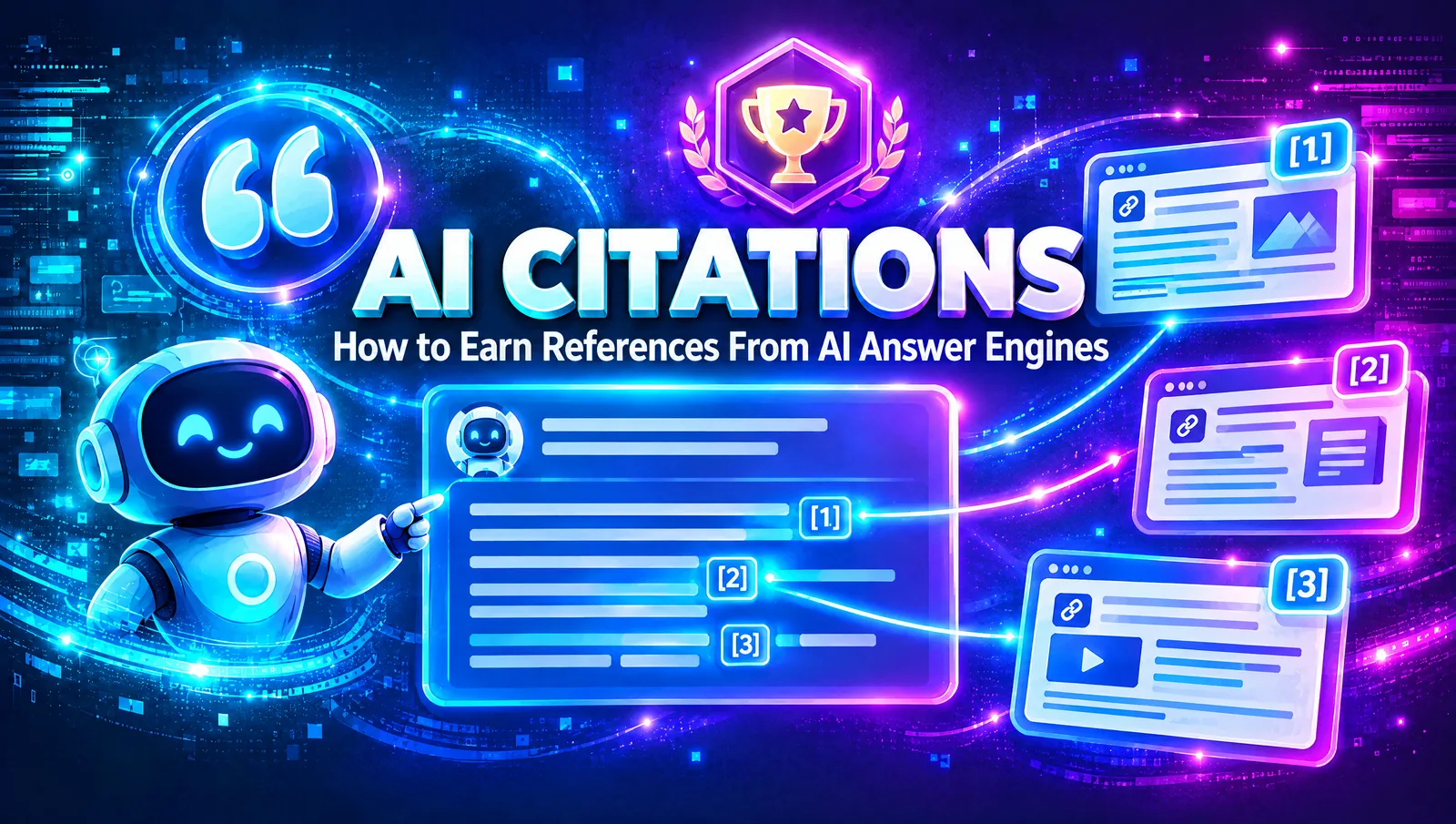
AI Citations: How to Earn References From AI Answer Engines
The buyer had done their homework before the demo. They shared a Perplexity comparison naming three software providers, with links to each company's documentation. Your product supported the same integration, but it wasn't mentioned. Now the sales team has to prove a capability the buyer thought was missing.
That is the kind of moment that makes AI citations worth investigating. A source link in an AI answer can put your evidence in front of someone comparing vendors. An omission can reveal a documentation problem, an outdated third-party description, or simply a different answer on that occasion.
The useful response is to inspect the sources, improve what buyers can verify, and monitor whether the same gap keeps appearing. This guide covers earning references in AI answers, not how students should cite AI-generated text in academic papers.
What Are AI Citations?
AI citations are visible references to sources within AI-generated answers. They may appear as linked footnotes, source cards, or links accompanying a claim. A citation points to a source; a brand mention names a company without necessarily linking to it. A product recommendation is another outcome entirely.
Those differences matter because a company can be recommended without its website being cited. Conversely, its research might be cited in an answer that recommends someone else's product.
| Appearance in an answer | What the reader sees | What to record | Business relevance |
|---|---|---|---|
| Linked citation | A link to the company's page or study | Exact URL, prompt, and assistant | Potential referral and evidence exposure |
| Unlinked mention | Company name without a source link | Name, context, and accuracy | Possible inclusion in buyer research |
| Product recommendation | Product included in a shortlist | Criteria and competitors named | Potential consideration |
| Attributed finding | Research or statistic credited to its origin | Source, date, and quoted claim | Visibility for original expertise |
Answer engine optimization (AEO) concerns information presented in direct answers. Generative engine optimization (GEO) examines visibility in AI-generated responses. Their relationship with conventional search is covered in Sorn.ai's comparison of AEO and SEO.
For a marketing team, AI search optimization starts by deciding which outcome it wants to observe. AI brand visibility includes both product mentions and linked sources, but they must not be counted as the same event.
Why Does an Answer Engine Cite One Source Instead of Another?
AI assistants do not use one shared citation algorithm. Search-supported responses may retrieve current web pages, combine information from several sources, and present links they consider relevant. Other responses rely more heavily on model knowledge or provide no source links at all.
Google explains retrieval-augmented generation and query fan-out in its guidance for AI Overviews and AI Mode. Its systems may gather related searches, retrieve relevant indexed pages, and use them in a generated answer. That guidance describes Google Search, not every AI assistant.
For publishers, three practical questions follow. Can the relevant system access the material? Does the page answer the buyer's specific question? Can a person verify the claim through a product document, original method, or credible supporting record?
LLM citations to third-party comparisons may support one narrow claim rather than an entire product recommendation. Read the linked passage before drawing conclusions.
Consider a buyer asking which billing platforms handle multiple legal entities. A homepage promising "flexible billing" provides little help. A maintained integration page naming supported entities, permissions, and exceptions offers evidence the buyer can use immediately.
No paragraph format, schema property, or backlink total guarantees AI citations. Treat the assistant's cited sources as evidence of what happened in that test, then investigate the pages themselves.
Start With an AI Citation Gap Analysis
An AI citation gap analysis compares the sources and brands appearing for relevant buyer questions with your existing content and verified capabilities. Its value lies in identifying a repairable gap, rather than collecting screenshots of competitor names.
Ask sales and customer success teams for questions from demos, lost deals, support tickets, and procurement reviews. Include category questions, feature comparisons, implementation requirements, and requests for alternatives. Select an initial set that reflects the revenue decisions your team handles.
For each prompt, capture the assistant, date, answer, cited URLs, brands named, and factual errors. Categorize what you find:
- Missing capability: Your product supports a requirement, but the public documentation doesn't describe it clearly.
- Weak evidence: Your page makes a claim without a useful method, specification, or dated source.
- Wrong identity: An old product name or former parent company appears in an external profile.
- Source mismatch: The assistant links to a directory or comparison page containing outdated information.
- No repeatable gap: A single answer omits the brand, but comparable tests produce different results.
Give each substantive issue an owner. Product teams verify capabilities, editors improve documentation, and PR teams handle appropriate outside corrections. Prioritize citation gaps by the buyer's decision, not the size of the query. A missing definition mention is less urgent than an incorrect security claim.
Monitoring how AI assistants describe your brand and competitors becomes useful when it leads to these specific tasks. If you want to establish a comparable baseline, book a Sorn.ai demo with the buyer questions your team already uses.
Make Important Pages Accessible Before Revising the Copy
AI citations based on live retrieval require accessible sources. Even strong research can go unseen behind an accidental block, broken canonical, or unreadable client-side application. Begin with technical access rather than rewriting paragraphs for an imaginary AI ranking factor.
Check whether the important pages are publicly accessible, return the intended status, and can be read without signing in. Review canonical URLs, internal links, and site protections that could reject legitimate crawlers.
For ChatGPT search, OpenAI's crawler documentation distinguishes OAI-SearchBot, which supports search results, from GPTBot, which relates to training. A site can allow search crawling while disallowing training crawling. Bot protection and other server rules still need checking.
Google's AI Search features use ordinary Search foundations. The company says special AI markup is unnecessary, although appropriate structured data remains useful for existing Search features. Use genuine Organization, Person, Article, Product, or other types where the visible page supports them. Sorn.ai's schema guide explains how those entities can be organized across a site.
An accurate schema node won't repair an incorrect integration table. Technical access gets the page into consideration; the underlying information still has to be worth reading.
Give Readers Evidence They Can Use, Not Just a Quotable Sentence
Useful source material answers a buyer's question without asking them to accept a marketing claim on faith. For product content, that means current specifications, supported use cases, limitations, and implementation details. For research, it means an identifiable dataset, time period, and method.
Headings and concise opening answers help a reader find the relevant passage. They do not require every paragraph to follow a fixed word count. A difficult procurement question may need a table or several paragraphs before the information is complete.
| Content element | A useful example | What it lets the reader verify | Weak alternative |
|---|---|---|---|
| Direct explanation | Supported workflow and prerequisites | Whether the product fits the requirement | A vague efficiency claim |
| Comparison table | Features checked against dated documentation | Differences between genuine options | Unverified competitor weaknesses |
| Original statistic | Sample, date, definition, and calculation | How the number was produced | An unsourced percentage |
| Expert contribution | Named specialist explaining a real process | Relevant knowledge and accountability | Invented expert quotation |
| Revision record | Updated product specifications with date | Which information remains applicable | A new date without a change |
The GEO: Generative Engine Optimization research paper, first posted in 2023, reported visibility gains of up to 40% in its experimental benchmark. That research examined specific interventions and simulated generative-search conditions. It does not establish that a particular content format produces the same outcome on today's assistants.
Use documented expertise and evidence where they improve the answer. An authentic implementation example is more compelling than another unsupported claim that the company is a market leader.
Build One Original Asset That Other Sources Can Reference
Original research can earn AI citations when it answers a question other people are already trying to resolve. A survey is not useful merely because it has a sample size; a benchmark needs a consistent definition and enough context to interpret the finding.
A fictional security software company, for example, might analyze configuration errors across consenting customer environments. A responsible report would explain which systems were eligible, the period studied, the exclusions, and the method used to classify errors. Readers could then decide whether its results apply to their own systems.
The strongest publication package can include the following assets:
- A clear summary of the main findings and practical limits.
- A methodology page describing collection and calculation.
- A downloadable or inspectable dataset where permission allows.
- A useful comparison or calculator that applies the findings.
- A named author or subject expert responsible for the work.
Schema.org's Dataset type can describe a genuine dataset, including its distribution and measurement details. It cannot make unsupported findings authoritative.
Publish the method alongside the conclusion. If a prospect challenges the number during a call, your team should know where the figure came from without asking the content writer to reconstruct it.
Which Link Building and Digital PR Work Helps?
Relevant links and coverage help people discover evidence, but AI assistants do not publish a universal rule assigning AI citations to backlinks. AI brand mentions may appear on review sites, in credible publications, and in community discussions without linking to a corporate homepage.
Build outreach around something a journalist, industry editor, or professional association might genuinely use. Offer original research, an informed explanation of a new industry development, or an expert who can discuss a specific technical problem.
A small research report may deserve a detailed industry publication rather than a large number of generic placements. A webinar transcript can preserve a real specialist's explanation. A third-party comparison may also need a factual correction when a product changes ownership or capabilities.
What About Reddit and Other Community Discussions?
First-hand discussions can be useful sources when they describe real experiences or problems. They are poor places for disguised marketing campaigns. Employees and paid contributors should disclose material connections when making endorsements.
The FTC's endorsement guidance explains disclosure obligations for relevant relationships. Fabricated reviews, planted conversations, and undisclosed paid praise undermine the credibility that digital PR is supposed to establish.
A reasonable campaign measures earned coverage, linked references, and the relevance of resulting enquiries. A placement that reaches the right specialist audience may be more useful than a generic mention on a larger site.
Turn a Missing Citation Into a Useful Page Improvement
Once the audit reveals an omission, examine what a cited source provides that your site lacks. Sometimes the problem is an incomplete product page. Sometimes the assistant cites a third-party comparison whose information needs updating. Other times, there is no meaningful gap to repair.
For a software integration question, the workflow might look like this:
- Verify the product capability with the technical owner.
- Review the specific cited pages for the buyer's question.
- Update your documentation with supported systems, prerequisites, and known limits.
- Link that documentation from the relevant product and comparison pages.
- Request corrections from outside publishers if their factual claims are outdated.
- Retest the same questions, recording any changes without assuming your edit caused them.
A useful change may improve sales conversations even if the assistant never cites the page. A prospect can now inspect the integration requirements without waiting for a technical demonstration.
For SaaS teams, product discovery and vendor evaluation in AI search often involve these specific feature questions. AI citations on a generic glossary term are less commercially revealing than inaccurate information about a required integration.
How Should AI Citation Tracking Work?
AI citations should be measured using a consistent sample. An assistant's answer may change between runs, and a citation appearing once should not be treated as permanent visibility. Define the questions, supported engines, and counting rules before comparing results.
Choose buyer prompts across discovery, comparison, and purchase intent. Test them on a repeatable schedule. Record linked source URLs separately from unlinked AI brand mentions and product recommendations. Capture the answer's context, since a cited page can also support a negative claim.
Suppose you test 50 prompts twice across four assistants. That produces 400 observed answers. If 32 contain a link to your domain, your citation rate is 8% within that tested sample. It is not an estimate of your entire market's AI search volume.
| Metric | Calculation | What it answers |
|---|---|---|
| Citation rate | Responses linking to your site / tested responses | How often your site appeared as a linked source |
| Brand mention rate | Responses naming your brand / tested responses | How often the brand appeared in the panel |
| Prompt coverage | Unique prompts with a citation / unique prompts tested | Which buyer questions produced any link |
| Citation accuracy | Reviewed correct citations / reviewed citations | Whether linked claims were represented accurately |
| Identifiable AI referrals | Sessions with recognized assistant referrers | Which observed website visits came from assistants |
Sorn.ai provides AI visibility tracking across ChatGPT, Gemini, Perplexity, and Claude. It monitors prompt appearances, citations, competitors, and brand descriptions. Its role is to show the evidence and gaps; content editing and external PR still require implementation.
To compare your own buyer questions across those assistants, schedule a Sorn.ai demo and bring the sources you are concerned about.
Google Search needs separate measurement. The Generative AI performance report in Search Console shows impressions for linked pages in AI Overviews and AI Mode. It does not provide prompt-by-prompt transcripts or feature-specific sales attribution.
When comparing AI citation tracking tools, assess engine coverage, source records, repeated testing, and report definitions. The differences among LLM visibility analysis tools can help frame those evaluation questions.
How Do Citations Relate to Pipeline?
AI citations can help someone investigate a vendor, but the path from an answer to a purchase is rarely fully visible. A buyer may encounter a brand, return days later by direct search, and speak to sales without remembering the original source.
Pew Research Center's 2025 study of Google AI summaries found that people clicked traditional results less often when a summary appeared. Source links within summaries received clicks in 1% of observed visits. That finding should inform expectations about referral traffic, not be converted into a B2B revenue forecast.
A practical report combines citation and AI visibility data with identifiable referrals, branded demand, qualified opportunities, and retained revenue. Separate directly measured conversions from possible earlier exposure. The comparison of LLM visibility and traditional SEO ROI is most useful when both programs share consistent opportunity and profit definitions.
For a CFO, the business case is the value of decisions improved and opportunities won, supported by actual records. A dashboard of citations alone doesn't settle the investment decision.
Do You Need an Agency, Software, or Your Own Team?
The right arrangement depends on which work your team cannot complete. A technically capable B2B marketing team may be able to publish accurate documentation and run its own research. It might still need software for repeatable multi-engine monitoring or external help with credible PR.
| Responsibility | In-house team | Monitoring software | Implementation partner |
|---|---|---|---|
| Select important buyer questions | Sales and marketing | Supports prompt tracking | Can facilitate research |
| Observe citations and competitors | Manual tests | Repeatable reporting | May analyze reports |
| Fix product pages and schema | Product, SEO, and engineering | Does not implement fixes | Can implement if contracted |
| Publish original research | Subject experts and editorial | Does not create research | Can assist with research production |
| Earn independent coverage | Internal communications | Does not place coverage | Can provide appropriate PR services |
| Review commercial results | CRM, finance, analytics | Visibility metrics | Can support attribution analysis |
Before buying generative engine optimization services, ask how prompts are selected, which assistants are supported, who owns corrections, and how the contract defines success. Be cautious about guaranteed citation timelines and vendor-produced authority scores presented as official platform metrics.
Sorn.ai is AI monitoring software, not a done-for-you citation-placement agency. Its team and product background explain the platform's approach, while your organization retains control of its content and external relationships.
A First-Month Citation Improvement Plan
A four-week review of AI citations can produce an actionable baseline without pretending to control an assistant's next answer.
Week 1: Gather 30 to 50 buyer questions. Capture answers and links across the assistants relevant to your audience. Record the biggest factual errors and missing product claims.
Week 2: Audit the most commercially important pages for accessibility, current specifications, useful evidence, and clear next steps. Assign corrections to the right owners.
Week 3: Improve one substantive asset. That might be a complete integration reference, a transparent comparison, or a research report with a published method. Share it with relevant industry contacts when it offers genuine value.
Week 4: Rerun the same prompts and examine changes in linked sources, mentions, and answer accuracy. Compare identifiable referrals and qualified enquiries where records exist. Keep unresolved issues on the next month's task list.
The deliverable is a clear list of corrected information, unresolved source problems, and commercially relevant questions for continued monitoring.
Frequently Asked Questions About AI Citations
How Much Do AI Citation Optimization Services Cost?
Pricing depends on tracked brands, prompts, platforms, reporting frequency, and implementation scope. Monitoring software is priced differently from content production or a digital PR retainer. Compare services against specific deliverables, including access to source evidence and responsibility for corrections.
How Long Does It Take to Earn an AI Citation?
There is no standard timeline. Search-enabled assistants can retrieve updated public pages, but they decide which sources to show for individual answers. Measure repeat appearances over time and investigate persistent errors rather than relying on a promised first-citation date.
Do Backlinks Still Matter for AI Citations?
Relevant links help people and search systems discover pages. They can support conventional SEO, but a backlink cannot guarantee inclusion in an AI answer. Independent mentions may help establish factual context, even when a publisher doesn't link to the brand.
Can Google Search Console Show My AI Overview Citations?
Search Console's Generative AI report shows linked-page impressions in Google AI Overviews and AI Mode. It does not provide every prompt, a complete citation transcript, or separate conversion data. Use it alongside the standard Search reports and appropriate assistant testing.
Does Blocking GPTBot Prevent ChatGPT From Citing a Website?
Not necessarily. OpenAI describes GPTBot and OAI-SearchBot as independent crawler controls. OAI-SearchBot supports ChatGPT search, while GPTBot concerns training crawling. Check the site's robots instructions and access rules for the search bot before drawing conclusions about citation eligibility.
Can You Pay to Be Cited in ChatGPT or Perplexity?
Advertising and sponsored content are separate from organic source references. Paying a publisher or agency does not guarantee that an assistant will cite a page. Disclose material relationships and evaluate earned editorial coverage on its own merits.
Are AI Citations Useful When They Send Little Traffic?
They can show that a source appeared during research, but the commercial effect needs separate evidence. Track relevant referrals, buyer feedback, qualified leads, and sales outcomes. A citation with little traffic may still merit investigation, especially for a high-value buying question.
What Is the Difference Between AI Citations and SEO Rankings?
SEO rankings describe the placement of links within conventional search results. AI citations are source references inside generated answers. The two can overlap when an assistant retrieves indexed pages, but ranking highly does not guarantee that a source appears in every response.
What the Next Prospect Should Find
The next time a buyer brings an AI shortlist to a demo, the account executive can share one current technical page. It explains the supported integration, its limits, and who maintains the information. The buyer can verify those facts without another round of emails.
Keep that page accurate, then check whether the sources buyers encounter reflect it. Bring your most important comparison questions to a Sorn.ai demo to review linked references and factual gaps across supported assistants.