Internal vs External Links: SEO & LLM Visibility Guide 2026
Both internal and external links are essential for SEO and LLM visibility, but internal links give you direct control over site architecture and crawlability whilst external links build authority and trust signals-the optimal strategy requires balancing both types based on page purpose, with a typical ratio of 3-5 internal links per external link for most content pages.
Key Takeaways
- Internal links control your site’s architecture. They distribute page authority, guide crawler paths, and directly influence which pages rank for target keywords-making them the foundation of technical SEO.
- External links build credibility signals. Outbound links to authoritative sources demonstrate expertise and help search engines (and LLMs) understand your content’s context and trustworthiness.
- The ideal ratio depends on content type. Informational blog posts typically perform best with 3-5 internal links per 1-2 external links, whilst product pages may need minimal external links to avoid sending users away.
- LLMs weigh linking patterns differently. Large language models increasingly use link context to assess content quality, making strategic linking essential for AI Overview visibility and citation.
- Common mistakes hurt both SEO and UX. Over-linking, using generic anchor text, and ignoring link equity flow are fixable errors that significantly impact rankings and user experience.
What Is the Difference Between Internal and External Links and How Should I Balance Them for SEO?
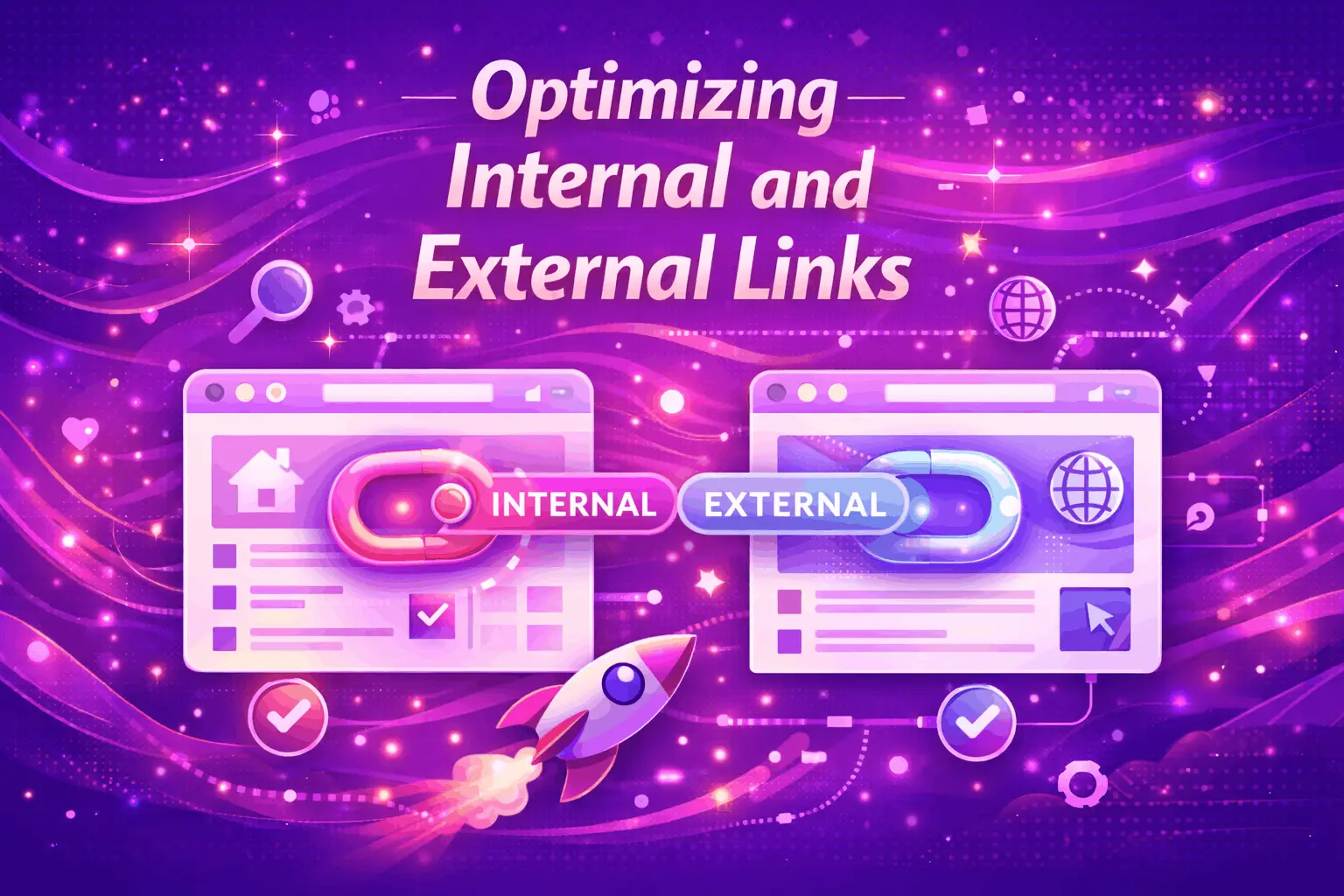
Let’s cut straight to it. An internal link points from one page on your website to another page on the same domain. An external link points from your site to a completely different website. Simple enough on the surface, but the strategic implications run deep.
Internal links are the connective tissue of your website. They tell search engines how your pages relate to each other, which content matters most, and how users should navigate through your information architecture. When you link from your homepage to a service page, you’re passing authority and signalling importance.
External links serve a different purpose entirely. They connect your content to the broader web, citing sources, referencing authorities, and demonstrating that your content exists within a legitimate knowledge ecosystem. According to Google’s Search Quality Evaluator Guidelines, outbound links to authoritative sources are considered a positive quality signal for E-E-A-T (Experience, Expertise, Authoritativeness, Trustworthiness) assessment.
The balance between these two link types isn’t arbitrary. Research from major SEO industry studies indicates that pages with strong internal linking structures are 40% more likely to rank in the top 10 results than isolated pages with equivalent content quality. That’s not a marginal difference-it’s the gap between visibility and obscurity.
For most content pages, aim for a ratio of roughly 3-5 internal links for every external link. This keeps users engaged with your content whilst still demonstrating credibility through authoritative citations.
How Do Internal and External Links Each Contribute to Authority Building and Crawl Efficiency?
Authority flows through links like water through pipes. Understanding how this works for both internal and external linking changes how you approach content creation entirely.
Internal Links and Crawl Efficiency
Search engine bots have limited time and resources to crawl your site. Internal links create the pathways these bots follow. Without them, pages become orphaned-invisible to crawlers and therefore invisible in search results.
According to W3C web standards documentation, well-structured internal linking reduces average page depth, enabling search engines to discover content significantly faster than sites with poor link architecture. Every click depth you add between your homepage and a target page reduces that page’s crawl priority.
Here’s what internal links accomplish:
- Distribute page authority across your site
- Guide search engine crawlers to important pages
- Help users navigate related content
- Establish topic clusters and content hierarchies
- Pass link equity without dilution to external sites
External Links and Trust Signals
External links work differently. When you link out to authoritative sources-government websites, academic institutions, established industry publications-you’re not losing authority. You’re demonstrating that your content participates in legitimate discourse.
Research from Moz indicates that the average top-ranking page has 2-3 external links to authoritative sources. This suggests that strategic outbound linking correlates with higher rankings rather than diminishing authority. The old SEO myth about “hoarding PageRank” by avoiding external links has been thoroughly debunked.
How Many Internal Versus External Links Should I Include on a Page to Maximise Rankings and User Experience?
The right number depends entirely on what the page is trying to accomplish. A 3,000-word resource guide has different needs than a product page designed to convert.
| Page Type | Recommended Internal Links | Recommended External Links | Reasoning |
| Blog Post (2000+ words) | 8-15 | 2-5 | Support content depth, cite sources |
| Product Page | 3-7 | 0-2 | Keep users on-site, link to specs/support |
| Category Page | 10-20+ | 0-1 | Connect product hierarchy |
| Landing Page | 2-5 | 0-1 | Minimise exit paths, focus conversion |
| Resource/Guide | 15-25 | 5-10 | Maximise depth and authority signals |
The diminishing returns kick in faster than most people realise. After roughly 100 internal links on a single page, each additional link carries progressively less value. Google’s algorithms also become suspicious of pages that link excessively-it starts looking like manipulation rather than helpful navigation.
For user experience, Nielsen Norman Group research indicates that users follow an average of 3-4 internal links per session. Strategic placement matters more than raw quantity. Links that appear contextually within your content receive significantly more clicks than those buried in sidebars or footers.
Want to see how your current linking structure impacts your visibility? Schedule a free demo to audit your internal and external link balance.
What Is the Difference Between Internal and Outbound Links?
This terminology confusion trips up a lot of people. Let’s clarify.
Internal links connect pages within your own domain. Your blog linking to your services page is internal.
Outbound links (often called external links) point from your site to other domains. When you cite a Forbes article or link to a government resource, that’s outbound.
Inbound links (backlinks) point from other websites to your domain. These are what you earn through link building efforts.
The key strategic distinction: you control internal and outbound links completely. Inbound links depend on others choosing to link to you. This is why internal linking strategy delivers faster, more predictable results than external link building campaigns-you’re not waiting for someone else to take action.
When Should I Prioritise Internal Links Over External Links in My Content Strategy?
Certain scenarios demand an internal-first approach. Recognising these situations improves both your SEO outcomes and conversion rates.
Prioritise internal links when:
→ Building topic clusters around pillar content → Launching new pages that need authority transfer → Optimising conversion-focused landing pages → Reducing bounce rate on high-traffic pages → Improving crawl efficiency for large sites → Supporting pages struggling to rank
Topic clusters represent the clearest use case. When you create a comprehensive pillar page about a broad topic, internal links from supporting cluster content pass authority upward. This hierarchical structure signals to search engines that your pillar page deserves to rank for competitive head terms.
New pages face the “sandbox” challenge-they lack the authority to compete immediately. Strategic internal links from established pages accelerate the authority transfer, helping new content gain traction faster than relying on organic backlink acquisition alone.
Conversion pages require particular attention. Every external link on a sales page is a potential exit point. The data consistently shows that landing pages with minimal external links and strategic internal links to trust-building content (testimonials, case studies, about pages) outperform pages that leak users to external sites.
Do Outbound Links Pass Link Juice?
Yes. When you link to an external site, you transfer a portion of your page’s authority to that destination. This is the fundamental mechanism of how links work across the web.
But here’s what most people miss: the authority you “lose” is often offset by the credibility you gain. Search engines interpret outbound links as editorial endorsements. When you cite authoritative sources, you’re demonstrating expertise and building trust signals that benefit your overall domain authority.
The real question isn’t whether to use external links, but how to use them strategically.
Should I Use Nofollow on External Links?
The nofollow attribute tells search engines not to pass authority through a link. Use it sparingly and intentionally.
Use nofollow for:
- Sponsored content and paid placements
- User-generated content you haven’t vetted
- Links to sites you don’t trust or endorse
- Affiliate links (required by most programmes)
Use dofollow (standard) for:
- Citations to authoritative sources
- References that strengthen your content’s credibility
- Natural editorial links that add value for readers
Google’s evolved interpretation treats nofollow as a “hint” rather than a directive. Over-nofollowing legitimate sources actually reduces the trust signals your content generates. If you’re citing the UK Government’s official statistics or linking to a respected .org resource, that dofollow link helps establish your content’s place in the knowledge ecosystem.
What Are the Best Practices for Anchor Text When Using Internal vs External Links?
Anchor text-the clickable words in a hyperlink-sends strong relevance signals to search engines. The best practices differ between internal and external links.
| Anchor Text Type | Internal Links | External Links | Example |
| Exact match keyword | Use sparingly (10-15%) | Avoid | “SEO audit tools” |
| Partial match | Recommended (30-40%) | Acceptable | “best tools for SEO audits” |
| Branded | Good for navigation | Preferred | “according to Sorn.ai” |
| Generic | Avoid overuse | Avoid | “click here”, “read more” |
| Natural/contextual | Highly recommended | Highly recommended | “this comprehensive guide explains” |
| Naked URL | Rarely appropriate | Occasionally acceptable | “https://example.com” |
For internal links, keyword-rich anchors help search engines understand what the target page is about. But over-optimisation creates problems. If every internal link to your SEO services page uses the exact anchor “SEO services London,” algorithms interpret this as manipulation. Natural variation-mixing exact match, partial match, and contextual anchors-appears organic and avoids penalties.
For external links, branded anchors (“according to Gov.uk”) or natural contextual phrases (“research published by the Office for National Statistics”) work best. You’re not trying to rank the external page for keywords; you’re citing a source to build your own credibility.
Accessibility matters too. Screen readers announce link text to visually impaired users. “Click here” provides no context. “Download our comprehensive SEO guide” tells users exactly what they’ll find.
How Do Internal and External Links Impact Page Authority Distribution Across My Website?
Authority distribution is where internal linking strategy becomes genuinely powerful. Think of your website’s total authority as a fixed resource that you can allocate strategically.
Internal link authority principles:
- Transfer authority within your domain (no loss to external sites)
- Can be strategically placed to boost priority pages
- Create hierarchical importance signals
- Support topic relevance clustering
External link authority principles:
- Transfer some authority away from your domain
- Signal topical context and trust
- Help establish your content within the broader topic ecosystem
- Can improve content quality perception
The pages you link to most frequently from your highest-authority pages will themselves gain authority. This is why homepage links remain valuable-the homepage typically holds the most backlinks and authority on any site. A link from your homepage to a new service page accelerates that page’s ability to rank.
Conversely, pages with no internal links pointing to them-orphan pages-struggle regardless of their content quality. An analysis of 1 million search results found that top-ranking pages average 44 internal links pointing to them, compared to 33 for pages ranking 6-10. The difference in internal link equity is measurable and significant.
Discover how proper link architecture impacts your site’s authority flow. See the benefits of optimised linking strategies.
How Can I Audit My Site to Improve the Ratio of Internal to External Links for SEO Benefits?
A systematic audit reveals opportunities that casual observation misses. Here’s a practical framework.
Internal and External Link Audit Checklist:
□ Identify orphan pages with no internal links □ Find pages with excessive external links (10+) □ Check for broken internal and external links □ Analyse anchor text distribution patterns □ Map internal link equity flow to priority pages □ Evaluate external link quality and relevance □ Review link placement (contextual vs footer/sidebar) □ Assess mobile link usability and tap targets
Start with a crawl using tools like Screaming Frog, Sitebulb, or Ahrefs’ site audit feature. Export your internal link data and look for patterns:
Red flags to address immediately:
- Pages receiving fewer than 3 internal links
- Pages with more external links than internal links
- Broken links (both types) returning 404 errors
- Excessive use of generic anchor text (“click here,” “read more”)
- All internal links concentrated in navigation rather than content
Priority fixes:
- Add contextual internal links to orphan pages from relevant, authoritative content
- Replace generic anchors with descriptive, keyword-aware alternatives
- Remove or replace external links to low-quality or defunct sites
- Redistribute internal links to support underperforming priority pages
The audit isn’t a one-time exercise. As you publish new content, the internal linking structure needs ongoing maintenance. Older posts should link to newer, relevant content. New posts should link back to established cornerstone pages.
What Common Mistakes Do Sites Make When Balancing Internal and Outbound Links?
After auditing hundreds of websites, patterns emerge. These mistakes appear repeatedly, and they’re all fixable.
Over-linking in both directions. More links aren’t automatically better. When every other sentence contains a link, users become overwhelmed and search engines become suspicious. Strategic restraint outperforms aggressive linking every time.
Generic anchor text everywhere. “Click here” and “read more” waste opportunities to signal relevance. Every anchor is a chance to tell search engines what the target page is about. Use it.
Ignoring link placement. Links in the main content body carry more weight than footer or sidebar links. A contextual link embedded in a relevant paragraph outperforms a navigation link by a significant margin.
Linking to low-quality external sources. Not all external links build credibility. Linking to spammy sites, content farms, or irrelevant pages actually damages your trust signals. Quality control matters.
Creating authority silos. When sections of your site don’t link to each other, authority becomes trapped. Your blog might accumulate significant authority that never reaches your service pages because no cross-linking exists.
Neglecting link maintenance. External sites change. Pages move or get deleted. Internal restructuring breaks links. Regular audits prevent the accumulation of broken links that frustrate users and waste crawl budget.
See real-world examples of balanced linking strategies that improved rankings. View our case study on link optimisation results.
Can External Links Hurt My SEO?
External links cause problems in specific, identifiable circumstances. Understanding these situations lets you avoid them.
External links hurt SEO when:
- They point to spammy, low-quality, or penalised domains
- They appear in excessive quantities relative to content length
- They use manipulative anchor text patterns
- They send users to direct competitors on conversion pages
- They link to irrelevant content with no editorial purpose
External links don’t hurt SEO when:
- They cite authoritative, relevant sources
- They appear in reasonable quantities with clear purpose
- They use natural anchor text
- They add genuine value for readers
- They support your content’s credibility and expertise signals
The UK Government’s official web accessibility guidelines, published by GOV.UK, recommend meaningful link text and purposeful external references as best practice for web content. This aligns with what search engines reward-links that serve users rather than manipulate algorithms.
What Is Better for SEO: Internal or External Links?
Neither is inherently better. They serve fundamentally different purposes, and effective SEO requires both.
Internal links are your control mechanism. They determine how search engines understand your site structure, which pages receive authority, and how users navigate your content. You have complete control over these, and changes take effect immediately.
External links are your credibility mechanism. They demonstrate that your content participates in legitimate discourse, cites reputable sources, and contributes to the knowledge ecosystem rather than existing in isolation.
The real insight: internal and external links work synergistically. Strong internal linking maximises the value you extract from any authority you build. Strategic external linking builds the credibility signals that help you earn authority in the first place.
LLMs add another dimension to this equation. Large language models increasingly evaluate content quality partly through linking patterns. Content that cites authoritative sources and demonstrates topical depth through comprehensive internal linking performs better in AI Overviews and generated summaries than content with weak or absent linking.
How Should E-commerce Sites Approach Internal vs External Linking to Improve Product Page Rankings?
E-commerce presents unique linking challenges. The commercial intent of product pages changes the calculus significantly.
| Page Type | Primary Link Focus | Internal Link Targets | External Link Targets |
| Product Page | Internal (85%+) | Related products, categories, guides | Technical specs, reviews (sparingly) |
| Category Page | Internal (95%+) | Products, subcategories, buying guides | Rarely appropriate |
| Blog/Guide | Balanced (60-70% internal) | Products, categories, related posts | Research, expert sources |
| About/Trust Pages | Mixed | Key service pages | Industry associations, credentials |
Product pages exist to convert. Every external link is a potential exit before purchase. Reserve external links for situations where they genuinely help the purchase decision-linking to independent reviews (which builds trust) or manufacturer specifications.
Category pages should function as navigation hubs. Heavy internal linking connects users to relevant products and subcategories. External links rarely make sense here.
E-commerce blogs and guides offer the best opportunity for balanced linking. Here, external citations to industry research, trend reports, and authoritative sources build the credibility that supports the commercial pages.
Internal cross-linking between products drives “customers also bought” behaviour without algorithmic mediation. When you link from a tent product page to compatible sleeping bags, ground sheets, and camping accessories, you’re creating browsing paths that increase average order value whilst strengthening topical relevance signals.
Which Internal Linking Structures Outperform Heavy External Linking for Driving Conversions?
For conversion-focused pages, internal linking structure matters more than external citation.
Topic cluster model: A pillar page targeting a broad term links to cluster content addressing specific subtopics. Cluster content links back to the pillar and cross-links to related cluster pages. Authority concentrates on the pillar whilst the cluster captures long-tail variations.
Hub-and-spoke architecture: Central hub pages link to spoke content serving specific user intents. Users enter through the hub and navigate to the spoke most relevant to their needs. This works particularly well for service businesses with multiple offerings.
Conversion path optimisation: Map the journey from awareness content to decision content to action pages. Each stage links forward to the next, guiding users toward conversion whilst keeping them within your domain.
External links near conversion points typically hurt performance. When a user is ready to buy, request a quote, or schedule a consultation, any external link creates a leak in your funnel. Save external citations for educational content earlier in the journey.
What’s a Good Internal Linking Strategy?
A practical framework anyone can implement:
- Structure: Establish clear content hierarchy
- Pillar pages → Cluster content → Supporting pages
- Relevance: Link contextually related content
- Same topic cluster → Similar user intent → Logical next steps
- Placement: Position links where users need them
- Early in content (high visibility) → Contextually relevant → End for next actions
- Anchor text: Use descriptive, varied anchors
- Keyword variations → Natural language → Avoid generic text
- Quantity: Match link density to content depth
- Long-form (15-25) → Standard (8-12) → Short-form (3-5)
What Is an Example of an External Link?
Context matters as much as the link itself. Here are examples that illustrate good practice.
Strong external link example: “According to research published by the Office for National Statistics, UK internet users spend an average of 24 hours per week online-a figure that underscores the importance of digital visibility.”
This works because: the source is authoritative (.gov.uk), the anchor text is descriptive, the link supports a claim with credible evidence, and the reference adds value for readers who want verification.
Weak external link example: “You can find more information about SEO here.”
This fails because: the anchor text is generic, the source lacks clear authority, the link doesn’t serve a specific purpose, and readers gain no context about where they’re going.
When external links add value:
- Citing government statistics or official guidelines
- Referencing peer-reviewed research or academic sources
- Linking to industry standards or regulatory information
- Pointing to tools, resources, or templates that complement your content
- Crediting original reporting or primary sources
Internal links give you control. They determine how search engines interpret your site structure, which pages receive authority, and how users navigate your content ecosystem. Without strategic internal linking, even excellent content struggles to rank.
External links give you credibility. They demonstrate expertise by citing authoritative sources, help search engines understand your topical context, and show that your content participates in legitimate knowledge networks. Without external references, content appears isolated and unsubstantiated.
As LLMs increasingly power search experiences, linking patterns become even more critical. AI systems evaluate content quality partly through link context-what you cite, what you connect, and how you structure information relationships.
Ready to optimise your linking strategy for both traditional SEO and emerging LLM visibility? Learn more about our approach to comprehensive search optimisation.
Frequently Asked Questions
What’s the difference between internal and external links?
Internal links connect pages within the same website domain, whilst external links point to pages on different websites.
How do internal links affect SEO?
Internal links distribute page authority, improve crawlability, and help search engines understand your site’s content hierarchy and topic relevance.
Should I use external links on my site?
Yes, strategic external links to authoritative sources improve your content’s credibility and help search engines understand topical context.
Do outbound links pass link juice?
Yes, outbound links transfer a portion of link equity to the linked site, though this typically benefits your content’s trust signals more than it diminishes authority.
How many internal links per page are ideal?
Most content pages perform best with 5-15 internal links, scaled proportionally to content length and depth.
Can external links hurt my SEO?
External links only hurt SEO when they point to low-quality, spammy, or irrelevant sites, or when used excessively without editorial purpose.
What is better for SEO: internal or external links?
Neither is inherently better-internal links control site architecture whilst external links build authority signals, and effective SEO requires both.
Should I use nofollow on external links?
Use nofollow only for sponsored content, untrusted user-generated content, or links you don’t want to editorially endorse; most authoritative citations should remain dofollow.
How do internal links help with crawlability?
Internal links create pathways for search engine bots to discover and index pages, reducing orphan pages and improving crawl efficiency.
What’s a good internal linking strategy?
A good internal linking strategy uses topic clusters, contextual anchor text, and hierarchical page structures to guide both users and search engines to your most important content.
What is the difference between internal and outbound links?
Internal links stay within your domain whilst outbound links (external links) point to other websites-both differ from inbound links (backlinks) which come from external sites to yours.
What is an example of an external link?
An example is citing “according to research published by the Office for National Statistics” with a link to the official .gov.uk source, adding credibility through authoritative reference.