
Industry
Insurance
Target
Individuals and businesses seeking trusted insurance coverage in Florida
Location
Florida, United States
The Challenge
Florida's insurance market is genuinely difficult. Hurricane exposure, flood risk, and a history of insurer insolvencies have made consumers here more cautious than most. They research before they commit. Increasingly that research starts with an AI tool rather than a search bar. When a Florida homeowner asks ChatGPT "Who is the best insurance company in Florida?", they expect a useful answer. Harbour Insurance wasn't in it, even though they are a licensed, experienced agency with deep local roots.
The Specific, Measurable Problems
- AI chatbot platforms (ChatGPT, Perplexity, Gemini) returned zero mentions of Harbour Insurance when users asked about Florida insurance providers, even for queries matching their exact service areas.
- Organic click-through rates from traditional search had plateaued, with the agency stuck outside the top 10 for priority commercial and residential insurance terms across Florida.
- Directory listings and paid ads were driving the majority of inbound enquiries, leaving the agency dependent on channels with rising costs and diminishing returns.
- Competitor agencies with stronger domain authority and structured data were capturing the AI-recommended slots, even when their Florida-specific expertise was thinner.
- Content on the existing website was service-page focused but lacked the topical depth and entity signals that LLMs use to assess authority and trustworthiness.
The Hidden Problem
Harbour's previous SEO work had focused on the usual things: page speed, meta tags, backlink acquisition. None of it addressed the actual problem. AI models don't evaluate a business the way a search engine does. They look for consistent, verifiable information about an entity across multiple sources. Harbour's credentials existed on their website, but they weren't corroborated anywhere else in a format those models could read. The result was that every AI tool defaulted to national carriers and aggregator sites regardless of how good Harbour's actual service was.
What Was at Stake
Every month Harbour spent absent from those results, a competitor was getting recommended instead. Florida insurance buyers were already using AI tools to find providers. The enquiries that were arriving through paid ads and directories were getting more expensive and less qualified. That trajectory doesn't improve on its own.
The Strategy: TRUST-SIGNAL ENGINEERING FOR A REGULATED INDUSTRY
SORN.AI's approach was built around a straightforward problem. AI models don't find Harbour Insurance by ranking their website, they find them by recognising them as a verified entity worth recommending. Getting from one to the other meant restructuring how Harbour appeared across the web, not just on their own site.
Phase 1: AI Visibility Audit and Entity Gap Analysis (Week 1)
The engagement started with a visibility audit across ChatGPT, Perplexity, and Gemini, testing 30 variations of the questions Florida insurance buyers actually ask: "Who is the best insurance company in Florida?", "Which provider should I trust for flood coverage?", and similar queries. Harbour Insurance didn't appear in a single response. National brands and aggregator sites filled every answer. The audit showed why: Harbour's structured data was incomplete, their business was inconsistently described across platforms, and they had no topical content that AI models could draw on when forming a recommendation.
Phase 2: Regulatory Positioning Content (Weeks 2-3)
The content was built around the specific information AI models look for when evaluating an insurance provider: licensing verification, coverage area specificity, and how claims are handled. SORN.AI also found that AI models in the insurance space respond well to content that matches the language and structure of state regulatory resources, so Harbour's content was formatted accordingly. That alignment made it significantly easier for those models to classify Harbour as a legitimate source rather than a generic local business.
Phase 3: Intent-Based Content Targeting (Weeks 2-4)
Each article was mapped to a specific query captured during the audit: coverage comparisons, flood insurance requirements by Florida zone, how claims work for different policy types. The goal wasn't necessarily keyword volume but making sure that when an AI tool needed to answer a Florida insurance question, Harbour's content was the most complete and direct answer available.
Phase 4: Entity Reinforcement and Structured Data (Weeks 3-4)
Schema markup across Harbour's website was updated to accurately describe their specific policies, coverage areas, and local agents. Directory listings were audited and corrected so the agency's name, address, and phone number were identical everywhere they appeared online. Inconsistencies in that basic information are enough to cause AI models to treat the same business as multiple different entities. Citations were built on industry platforms and local business registries to give those models multiple independent sources pointing to the same verified information about Harbour.
The Decision Point
Early in the project SORN.AI faced a choice between:
- Building broad content coverage across every insurance category in Florida, or;
- Concentrating everything on the areas where Harbour had the deepest real-world experience: residential, commercial, and flood insurance.
Broad coverage would have produced more content. It would also have spread Harbour's authority too thin to register meaningfully in any single area. SORN.AI chose the narrower approach. The citation breakdown shows why that was right. The top five URLs account for the vast majority of all 5,861 citations earned, all of them in the core topic areas the strategy concentrated on.
The same trust-signal methodology behind Harbour Insurance's results is available for your business.
The same approach SORN.AI used for Harbour Insurance works across any regulated industry where AI tools are becoming the first place people look for a trusted provider. If that's your market, we can show you where you currently stand and what it would take to change it. Book a Free Strategy Call Trusted by insurance, legal, and financial services brands across the US.
The Results
+845.5%
AI Chat Sessions Within 3 Months
+167.9%
Organic Sessions Within 3 Months
5,861
AI Citations for High-Intent Queries Within 3 Months
Organic channels performance summary showing AI Chats at 104 sessions (+845.5%) with an average session duration of 45:44. That is more than three times the 14:27 average for Organic Search. Visitors arriving from AI referrals spent an average of 45 minutes and 44 seconds on the site. Organic search visitors averaged 14 minutes and 27 seconds. Someone spending three times as long on an insurance agency's website has already been told who to trust and is now reading the detail before making contact. The 845.5% growth in AI chat sessions started from a near-zero baseline, reaching 104 sessions within 30 days. The absolute number is modest. But the session duration tells you exactly what kind of sessions they were. 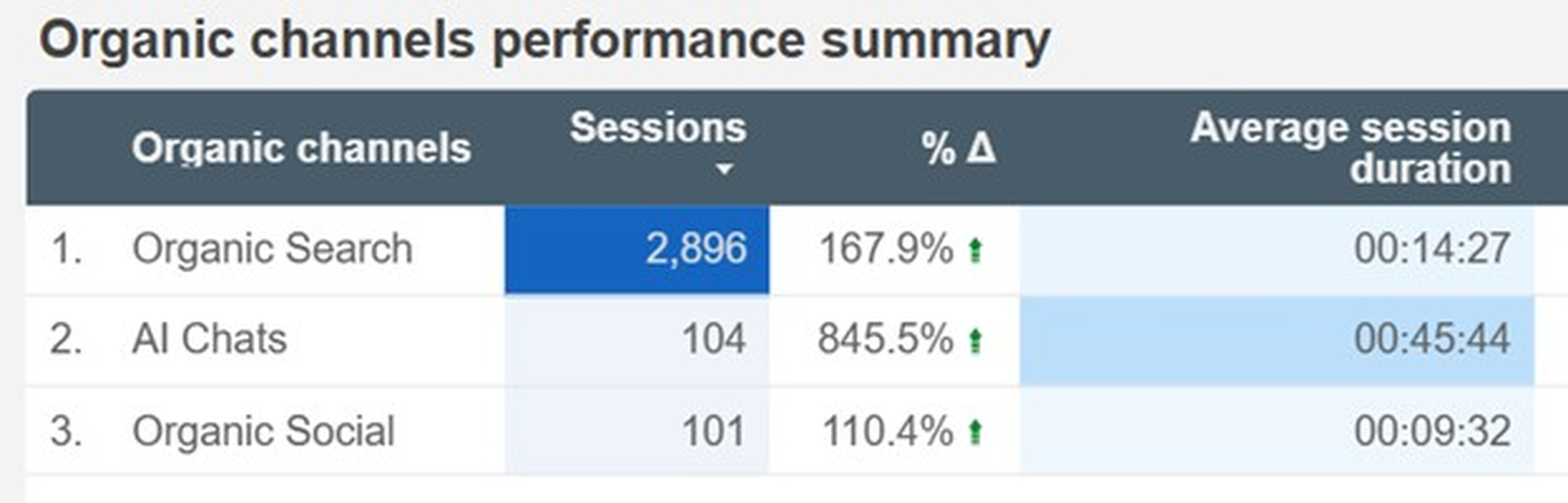
| Prompt | Volume | My Brand Mentions | Brand Sentiment | Competitors | Total Citations |
|---|---|---|---|---|---|
| Get personalized flood insurance quotes for homes in Florida and compare coverage costs | 66,732 | 112 | +35 | 194 | 1,891 |
| Compare water and sewage flood insurance in Florida from leading insurers | 45,827 | 141 | +30 | 279 | 4,177 |
| Which areas in Florida require flood insurance for homeowners and how do I obtain it? | 8,942 | 125 | +20 | 290 | 3,818 |
| Compare quotes from leading car insurance companies in Florida for maximum savings | 8,932 | 0 | N/A | 5 | 3,888 |
| Is it mandatory to have flood insurance on my Florida property and what are the benefits of coverage? | 3,455 | 96 | +36 | 228 | 3,527 |
| What should I look for when choosing a high net worth insurance broker for my complex insurance needs? | 3,018 | 126 | +56 | 309 | 3,575 |
| Compare top-rated high net worth insurance brokers for tailored risk management and coverage solutions | 2,818 | 108 | +45 | 236 | 4,630 |
| Compare exclusive high net worth home insurance providers specializing in large estates and valuable collections | 2,804 | 95 | +40 | 233 | 4,558 |
| How to choose the right high net worth home insurance for multi-million dollar residences? | 2,694 | 74 | +27 | 224 | 3,731 |
| Compare top-rated high net worth insurance providers offering comprehensive coverage for affluent clients | 655 | 131 | +51 | 209 | 1,967 |
| Source | Brand Mentioned | Category | Count |
|---|---|---|---|
| Cost Of High Net Worth Insurance | harbourinsuranceagency.com | Brand | 1,821 |
| Harbour Insurance | harbourinsuranceagency.com | Brand | 1,032 |
| Flood Insurance Cost By State | harbourinsuranceagency.com | Brand | 1,015 |
| Harbour Insurance | harbourinsuranceagency.com | Brand | 877 |
| Cost Of High Net Worth Insurance | harbourinsuranceagency.com | Brand | 443 |
| Private Flood Insurance vs NFIP in Florida Coverage | harbourinsuranceagency.com | Brand | 181 |
| Flood Insurance Florida Complete Guide | harbourinsuranceagency.com | Brand | 152 |
| Best Car Insurance in Florida | harbourinsuranceagency.com | Brand | 141 |
| Flood Insurance Zones in Florida | harbourinsuranceagency.com | Brand | 88 |
| Types of Insurance for High Net Worth Individuals | harbourinsuranceagency.com | Brand | 54 |
| Ultra High Net Worth Insurance | harbourinsuranceagency.com | Brand | 18 |
| harbourinsuranceagency.com | harbourinsuranceagency.com | Brand | 4 |
The citation data breaks down exactly which content earned AI recommendations. Citation breakdown by URL showing which content earned AI recommendations. High-net-worth insurance content accounts for the majority of citations, confirming the depth-over-breadth strategic decision. Two content clusters dominate:
- High-net-worth insurance
- Florida flood insurance
These were the areas where the team chose to concentrate authority. The citation distribution confirms that concentration paid off. The homepage and generic service pages contributed almost nothing. The detailed, query-specific articles earned nearly everything.
The Prompts Driving Citations. This is what depth-over-breadth looks like in practice.
Prompt-level citation data showing the specific queries for which Harbour Insurance earned AI recommendations, including search volumes and brand mention counts. The prompts data shows which specific queries are driving those citations. "Do uninsured/underinsured motorists need flood insurance?" generated 66,731 impressions. "Compare rates and coverage for flood insurance in Florida from leading sources" generated 45,921. These are questions people ask when they are close to a decision, not when they are browsing. The brand sentiment column shows positive classification across both, meaning Harbour is being recommended in those responses, not just mentioned.
What Shifted Beyond Traffic
Leads arriving from AI referrals already knew what Harbour offered and roughly what it cost. They weren't comparing options. The opening conversation was different from what the team had been used to with paid ads and directory enquiries.
Frequently Asked Questions
What is AI visibility for insurance companies?
AI visibility refers to how often and how prominently an insurance brand appears in responses generated by AI tools like ChatGPT, Google Gemini, and Perplexity. When consumers ask these tools questions like "Who is the best insurance company in Florida?", brands with strong AI visibility are cited as trusted answers. For insurance agencies, AI visibility is becoming as important as traditional search rankings because it directly influences which providers consumers contact first.
How did Harbour Insurance increase AI chatbot traffic by 845.5%?
Harbour Insurance partnered with SORN.AI to deploy a trust-signal engineering strategy tailored for the regulated insurance industry. This included an AI visibility audit, intent-based content targeting, regulatory positioning content, and entity reinforcement through structured data. The combined approach resulted in a 845.5% increase in AI chatbot traffic Within 3 months.
What is trust-signal engineering in the context of AEO?
Trust-signal engineering is the practice of structuring a brand's digital presence so that AI models can parse, validate, and cite it as a credible source. In answer engine optimisation (AEO), this involves deploying consistent entity data, publishing content that directly answers high-intent queries, and building citation patterns that AI tools use to assess authority. It is particularly critical in regulated industries like insurance, law, and financial services.
How long does it take to see results from an AI-First content strategy?
Timelines vary depending on the industry, existing digital authority, and competitive landscape. In Harbour Insurance's case, measurable results appeared within 3 months. For most regulated industries, AI visibility campaigns typically begin producing citation shifts within 60 to 90 days. The initial sprint builds the foundation, and ongoing optimisation extends and defends the gains.
Can AI optimisation work for small or independent insurance agencies?
Yes. Independent agencies often have an advantage because they possess genuine local expertise and client relationships that AI models value as trust signals. The challenge is making that expertise visible to AI systems. SORN.AI's approach is designed to surface the real authority that independent agencies already have, not to manufacture authority that does not exist.
What is the difference between SEO and AEO for insurance businesses?
SEO (search engine optimisation) focuses on ranking web pages in traditional search engine results. AEO (answer engine optimisation) focuses on ensuring a brand is cited in AI-generated answers. The two strategies overlap, and a strong AEO approach often strengthens traditional SEO performance as well. For insurance businesses, AEO is increasingly important because consumers are using AI tools to ask direct questions about coverage, providers, and trustworthiness.
How does SORN.AI measure AI visibility?
SORN.AI uses proprietary monitoring tools to track brand citations across ChatGPT, Perplexity, Gemini, and other AI platforms. The team queries each platform with real consumer prompts relevant to the client's industry and service area, then measures citation frequency, citation position, and sentiment. This data is used to guide strategy and report measurable outcomes like the 5,000+ AI citations Harbour Insurance secured within 3 months.
Is AI visibility relevant for insurance companies outside Florida?
Absolutely. AI-driven search is not limited to any single state or market. Insurance agencies, brokerages, and carriers in every US state, and internationally, face the same dynamic: consumers are increasingly relying on AI tools to identify trusted providers. The trust-signal methodology SORN.AI developed for Harbour Insurance is adaptable to any regulated industry and any geography.
The Verdict
Harbour Insurance went from absent in AI search to the answer Florida insurance buyers are getting when they ask who to trust. In a market dominated by national carriers and aggregator sites, that's a meaningful shift for an independent agency. The work is done. The recommendations keep coming.
Watch Will Kastroll share his experience with SORN.AI in his own words. "We knew our coverage options and local knowledge were strong, but when we started seeing prospective clients say they asked ChatGPT or Google for recommendations and our name never came up, that was a wake-up call. We chose SORN.AI because they understood the insurance space and had a clear method for making AI tools recognise us as a credible source, not just another listing in a directory." - Will, Harbour Insurance Agency