How to Optimize for Google AI Mode in 2027
An equipment manufacturer's website says its industrial pumps are "built for demanding environments." Its technical manuals tell a more useful story: seal materials, operating temperatures, fluid compatibility, and maintenance requirements.
A purchasing manager asking Google AI Mode about pumps for abrasive liquids needs those specifications. The marketing copy leaves most of the decision unanswered, even though the manufacturer has the information somewhere else.
If you're considering how to optimize for Google AI Mode, that gap is a better starting point than rewriting every headline. You need pages that can answer detailed questions, a site Google can access, and a way to see what happens afterward. The process below brings those pieces together, including where Sorn.ai can help with visibility beyond Google Search.
What Google AI Mode Does With a Complicated Question
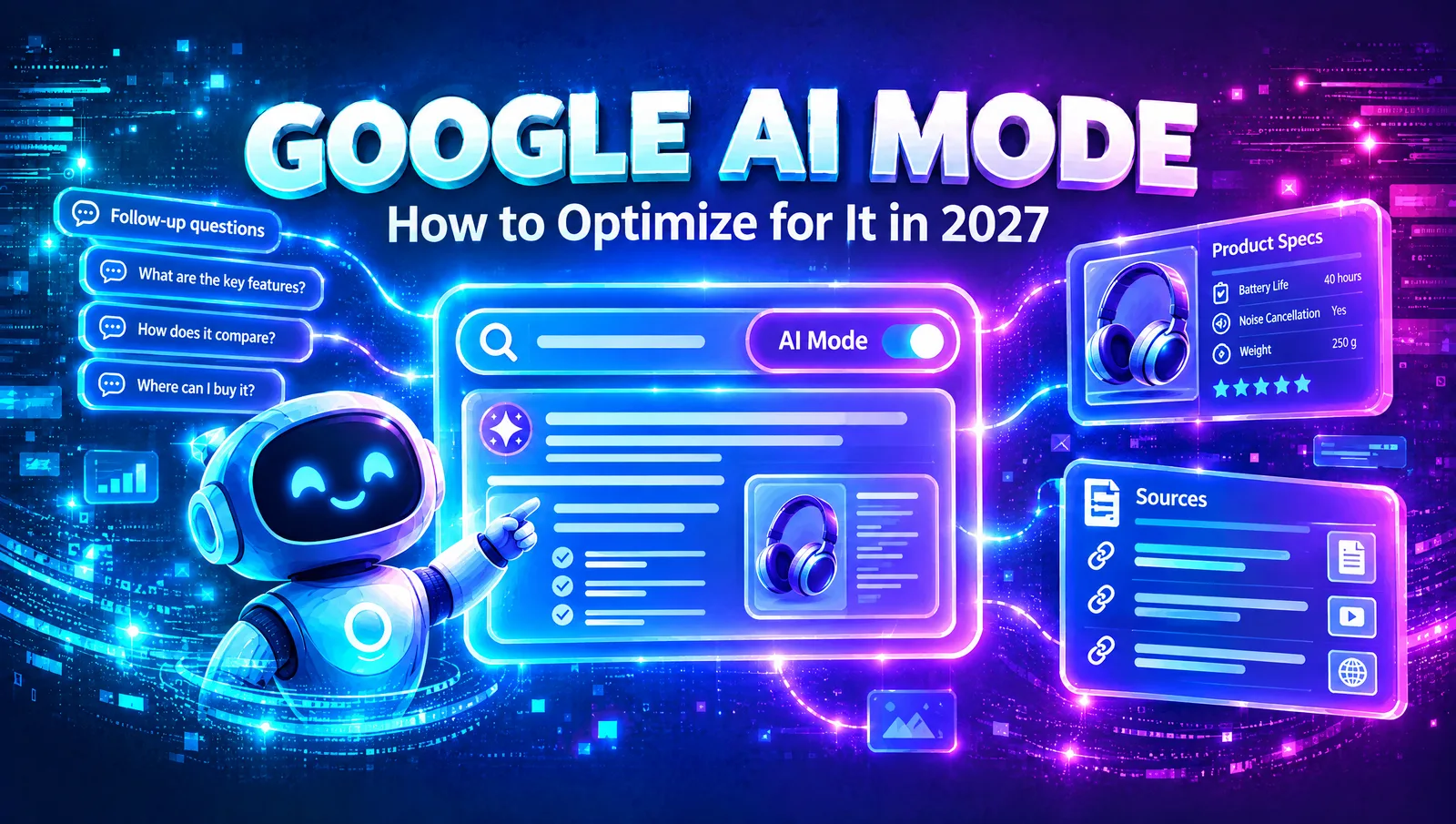
AI Mode lets someone continue a search as a conversation. A buyer can ask for suitable industrial pumps, then narrow the request by temperature, maintenance requirements, or compatibility with existing equipment. The response may include links to different websites that address parts of the request.
Google uses Gemini technology and its existing Search infrastructure in this experience. Through query fan-out, it can issue several related searches to investigate a broader question. A request about an industrial pump might lead to research on seal materials, installation requirements, and comparable products. These are illustrative subtopics, not a transcript of Google's internal searches.
Google's guidance for generative Search confirms that AI Mode draws on established ranking and quality systems. It also stresses original, helpful information over content manufactured to capture every possible question variation.
Where AI Mode Differs From AI Overviews
AI Overviews appear within some ordinary Google results pages. AI Mode is a dedicated experience where follow-up questions can carry the research forward. Both can connect people with supporting sources, but they don't necessarily display the same pages for a related question.
Google's indexing and quality systems still matter, while research and purchasing decisions may unfold across several interactions. Some AI Overviews optimization work carries over because the two experiences share Search foundations.
Knowing how to optimize for Google AI Mode therefore starts with identifying the answers Google could retrieve from your existing pages. It doesn't require treating each follow-up as a new keyword landing page.
Establish Eligibility Before Changing Content
A beautifully written page is little use in generative Search if Google cannot index it. A Google AI Mode SEO audit should begin with the URLs that generate your most important enquiries or sales.
Google requires a page to be indexed, eligible for a Search snippet, and covered by the site's generative AI inclusion setting. Those conditions establish eligibility, not a guarantee of appearance.
| Check | Where to check it | Action if something is wrong |
|---|---|---|
| Google has indexed the intended URL | Search Console URL Inspection | Resolve noindex, canonical, or discovery problems |
| The page can appear with a snippet | Indexing directives and snippet controls | Review unintended restrictions |
| Generative AI inclusion is enabled | Search Console > Settings > Search generative AI | Check the property's setting and inherited controls |
| Key information is accessible | URL Inspection rendered page and site testing | Fix blocked resources or missing rendered content |
| Supporting pages are discoverable | Internal navigation and XML sitemap | Repair broken paths and outdated sitemap entries |
Google's Search generative AI control was rolled out worldwide by August 31, 2026. Inclusion is the default, although individual properties can inherit a different setting. The control covers AI Mode, AI Overviews, and supported generative features in Discover.
For JavaScript-heavy sites, compare the rendered page with what a customer sees. A specification hidden behind a broken interface may deserve more attention than a slow but otherwise accessible blog page.
Structured Data Helps Describe Pages, Not Secure AI Citations
Use Product and Offer markup for eligible product pages, LocalBusiness information where appropriate, and accurate Organization or BreadcrumbList markup elsewhere. Match structured data to visible content and validate supported rich-result types.
The choice of schema types should reflect what each page represents. Google requires no special AI Mode markup or llms.txt file. Its FAQ rich-result feature was retired in May 2026, though relevant questions can still belong in the page's actual content.
For site owners researching how to optimize for Google AI Mode, these checks prevent avoidable access problems from being mistaken for weak copy.
Give Your Best Pages Answers Buyers Can Use
The next stage is editorial. Read the pages responsible for demo requests, purchases, or appointment bookings, and compare their content with the questions customers ask before committing.
Begin With the Questions Your Staff Already Answers
Sales and support conversations offer a grounded way to learn how to optimize websites for Google AI Mode. Collect a small sample of recurring customer questions before brainstorming new content.
For a supplier of industrial equipment, the repeated questions might involve replacement-part compatibility, expected service intervals, and installation requirements. Those details often belong on the product page or a clearly linked technical document, not a new generic article.
Replace Promotional Shorthand With Verified Details
Phrases such as "flexible integration" or "easy maintenance" give customers little basis for comparison. Publish the conditions and specifications behind the claim, as long as they can be verified.
| Generic statement | More informative alternative, if supported by product records |
|---|---|
| "Works with your existing systems" | "Supports CSV imports and a documented Salesforce connector" |
| "Low-maintenance design" | "The maintenance manual specifies inspection intervals and replaceable seal components" |
| "Flexible deployment" | "Available for on-premises installation or a vendor-hosted environment" |
These examples describe hypothetical products. Your actual wording must reflect documented capabilities, plan restrictions, and current specifications.
A related problem is inconsistent naming across product pages, support articles, and directories. Clear entity relationships between brands, products, and services help readers understand what belongs together. Use the same product names and supported feature descriptions wherever the business publishes them.
Put the Evidence Near the Claim
A performance figure is useful when its source, conditions, and date are visible. An installation claim benefits from a documented procedure. A comparison gains credibility when the testing criteria are disclosed.
This is especially important in finance, law, and healthcare, where bad information can affect consequential decisions. Transparent authorship, appropriate review, and source checks belong in a serious E-E-A-T assessment.
Avoid presenting a fabricated testimonial or a hypothetical example as proof. Original measurements and credible limitations are much more useful than a row of unsupported superlatives.
Make Information Easy to Follow Across Pages
An overview can explain a product family, while a specification page answers detailed engineering questions. A pricing page can link to implementation requirements or exclusions without repeating every paragraph.
Use readable headings and comparison tables where they help. Google does not require artificial 50-word chunks, mandatory question headings, or a separate URL for each possible fan-out query.
For those asking how to rank in Google AI Mode, there is no fixed citation position to pursue. For a manufacturer deciding how to optimize for Google AI Mode, the work might be linking the latest compatibility chart from each product page. Publishing volume should follow genuine information needs, not the number of prompts a team can brainstorm.
What Buyers Need From Ecommerce, SaaS, and Local Service Pages
Different businesses have different information bottlenecks. Choose details that help a customer make a decision, then make them accessible in the right place.
Ecommerce: A Product Record That Can Survive Comparison
An office furniture shopper may ask for a chair suitable for a tall person, a narrow desk, and a particular budget. Useful pages provide seat-height range, overall width, adjustable features, warranty terms, and availability.
A category page can explain differences between task chairs and executive chairs. The individual product page should carry precise measurements and purchasing conditions. Consistent price, stock, shipping, and returns information also belongs in the merchant feed.
Google's merchant listing requirements explain supported Product and Offer details for eligible pages. Accurate product records form part of answer engine optimization for ecommerce product pages, especially when shoppers compare several alternatives.
For retailers, how to optimize for Google AI Mode often means correcting missing attributes and feed discrepancies before investing in more buying guides.
SaaS: Show the Limits of the Integration
Suppose a finance team wants expense software that connects with its existing accounting system. A logo saying "integrated" leaves open the most expensive questions: Which fields sync? Is the connection one-way? Who handles implementation?
An integration page can name supported objects, synchronization timing, user permissions, and known restrictions. Pricing should distinguish standard access from paid implementation or advanced features.
A customer comparing several vendors can then inspect real differences. The same work strengthens your sales material, because the sales team no longer needs to correct vague product claims after a prospect asks for details.
Local Services: Make the Appointment Decision Easier
A patient researching a diagnostic imaging clinic may need to know whether referrals are required, which scans are available, how preparation works, and whether insurance is accepted. Service pages should answer those administrative questions accurately, while clinical claims receive appropriate professional review.
Eligible businesses can maintain opening hours, service areas, and booking links through Google Business Profile. Location pages should reflect genuine differences between offices, including the services offered at each one.
For a clinic exploring how to optimize for Google AI Mode, this may be a matter of correcting appointment information rather than publishing another broad health article. Strong E-E-A-T checks for YMYL websites also account for qualifications, evidence, and accuracy.
Measure Exposure Without Guessing at AI Mode Clicks
Google changed the reporting available to site owners during 2026. Teams can now inspect impressions for linked pages appearing in supported generative Search features, rather than relying solely on ordinary Web performance.
The Generative AI performance report includes AI Overviews and AI Mode impressions. It can break results down by linked page, country, device, date, and supported text or multimodal search type.
An impression is an appearance of a linked page, not evidence that someone clicked or purchased. The report doesn't provide a complete list of prompts mentioning your brand or a separate AI Mode conversion figure.
| Question | Source | What you can establish |
|---|---|---|
| Which URLs appear in Google's generative features? | Search Console Generative AI report | Linked-page impressions and trends |
| Which landing pages bring visitors? | Standard Search Console and GA4 | Search traffic and engagement |
| Are enquiries or sales recorded? | Forms, ecommerce reporting, and CRM | Identifiable conversions and qualified leads |
| Are other assistants naming our brand correctly? | Sorn.ai monitoring | Mentions, citations, and factual inaccuracies in tested responses |
How to Track AI Mode Traffic Alongside Revenue
GA4 can record a visit from Google Search, but it doesn't reliably separate AI Mode clicks into their own acquisition channel. Long question-shaped keywords are not a substitute for that missing identification.
If you need to know how to optimize for Google AI Mode based on outcomes, compare generative impressions with landing-page engagement and recorded enquiries. A rise in both is worth investigating, but isn't enough to claim that one caused the other.
For a business with longer sales cycles, a short discovery question on the lead form can add context. Keep the self-reported answer separate from verified referral data, then examine lead quality rather than raw traffic alone.
Sorn.ai Turns Broader AI Mentions Into a Worklist
Search Console answers important questions about Google's generative Search impressions. Another part of the customer journey happens in ChatGPT, Perplexity, Gemini, and Claude, where a business may be described inaccurately or excluded from a comparison altogether.
Sorn.ai tracks visibility across those four assistants, including prompt appearances, cited sources, competitor mentions, and brand description accuracy. It also offers crawler activity monitoring. Its published coverage is distinct from Google's AI Mode impression report.
Consider a software company tracking these buyer questions:
- "Which field-service platforms support offline mobile forms?"
- "Which providers integrate with NetSuite?"
- "Which options support approval workflows for regional managers?"
A Sorn.ai report might reveal that the company appears for the first question but not the second. Another tested answer could describe a supported feature incorrectly. These are hypothetical findings, but each points to a different task.
The content team can check whether the NetSuite integration page is complete. Product management can confirm the feature description. Marketing can inspect the cited third-party source for outdated information.
A useful monitoring cycle looks like this:
- Select prompts tied to buying decisions. Keep the same market and question wording for meaningful comparisons over time.
- Record appearances and citations. Distinguish a brand mention from a link to the company's own page.
- Inspect competitor context. Find the subjects where competing products consistently appear in tested answers.
- Assign factual corrections. Give missing specifications to product owners and site changes to the content or development team.
- Repeat the tests. Check whether the pattern changes without interpreting one response as a permanent ranking.
The work resembles LLM brand monitoring because descriptions, citations, and competitor context need separate attention. It also gives a practical reason to review LLM visibility analysis tools by prompt coverage and evidence, not just a summary score.
Sorn.ai helps identify opportunities across its supported assistants. Google Search Console remains the place to examine impressions specifically from AI Mode and AI Overviews.
Prioritize the First 90 Days by Commercial Value
An SEO optimization for AI Mode project can produce hundreds of suggested tasks before anyone has checked the pages responsible for qualified leads. Begin with a manageable group of those pages and assign someone to verify each correction.
| Period | Main work | Useful deliverable |
|---|---|---|
| Days 1–30 | Check access, gather customer questions, baseline Search Console and assistant visibility | A prioritized list of pages and missing facts |
| Days 31–60 | Correct specifications, service details, schema errors, and supporting links | A change log with owners and dates |
| Days 61–90 | Compare reporting periods, inspect lead quality, retest assistant prompts | A short list of observed changes and the next improvements |
Select pages using commercial relevance, missing information, and the effort required to make a reliable correction. A high-intent product page with outdated specifications can deserve attention before a low-traffic informational article.
Teams planning how to optimize for Google AI Mode should record what changed and when. That gives the analyst a basis for comparing later impressions without crediting every movement to one edit.
If Google eligibility and page quality are already strong, the next question may be competitive visibility in other assistants. Sorn.ai's prompt and citation monitoring platform can help teams identify what those tested answers say about their category.
Decide Whether the Gap Is Technical, Editorial, or Analytical
Not every organization needs a new agency relationship. A capable SEO team with developer access and product experts can handle indexing checks, factual updates, and much of the content work.
An enterprise deciding how to optimize for Google AI Mode should assign responsibility by problem: developers fix accessibility, specialists verify technical claims, and marketing identifies customer questions.
Specialist services can be useful when a catalog has thousands of URLs, technical problems cross several systems, or nobody owns the reporting workflow. Ask prospective providers for specific deliverables, not guaranteed citations.
A shared Google AI Mode and SEO strategy should use the same source of truth for important product and service information. The balance between answer optimization and traditional SEO depends on the gaps your team can document.
The tools used to optimize for Google AI Mode should reflect the work. Search Console diagnoses Google visibility; product teams verify facts; content teams publish corrections. Sorn.ai provides a separate view of how supported assistants mention brands and competitors.
The Sorn.ai team brings AI visibility expertise alongside its monitoring platform. A demo discussion can focus on the buyer questions your company most wants to understand across the assistants Sorn.ai supports.
Frequently Asked Questions About Google AI Mode Optimization
Is Traditional SEO Still Necessary for AI Mode?
Yes. Google's generative Search features rely on core Search ranking and quality systems. Pages must satisfy indexing and snippet eligibility requirements, along with the site's generative AI inclusion setting. Continue maintaining organic search performance while evaluating the new impression report.
Can a Page Appear Without Ranking First in Google?
Yes. AI Mode can retrieve relevant material through several related searches. A first-place organic ranking isn't a formal requirement. Google's source selection varies with the question, and meeting technical eligibility requirements does not guarantee an appearance.
Does Google AI Mode Use the Same Results as Gemini?
No. AI Mode operates within Google Search and uses Gemini technology, while the standalone Gemini assistant is a different experience. The products can answer similar questions, but their retrieval behavior and reporting should be evaluated separately.
Do I Need an llms.txt File or AI-Specific Schema?
No. Google states that neither special AI markup nor an llms.txt file is needed for generative Search. Use standard structured data where it accurately describes an eligible page and supports relevant Search features.
Why Don't I See the Generative AI Report in Search Console?
Google says a site may not have accumulated enough impressions in supported generative features to display the report. Check the site's generative AI inclusion setting as well. Its availability does not mean every website already has measurable impressions.
Can I Stop My Pages From Appearing in AI Mode?
Yes. Search Console offers a Search generative AI control that covers AI Mode and AI Overviews. It can inherit a parent property's setting. This control is separate from normal Search indexing and does not serve as an AI training opt-out.
How Long Before Updated Pages Appear in AI Mode?
There is no fixed timetable. Google must discover and process the changes, then select relevant sources for particular questions. Track the page's indexing status and compare generative impressions over consistent periods rather than assuming a citation deadline.
The Question Your Sales Team Answered Twice This Week
Before commissioning another AI search article, ask a salesperson or product specialist which question keeps coming back from interested buyers. Find the page where the answer belongs. If the explanation is missing, trapped in a manual, or contradicted elsewhere, that is a concrete improvement to make.
A page that can settle a buyer's next question is a useful asset, regardless of which search experience brings the visitor. For anyone still deciding how to optimize for Google AI Mode, start with that one page and measure what changes.
Then bring the same buyer questions into a Sorn.ai consultation. You can examine how supported AI assistants describe your company, which competitors enter the conversation, and where the next factual corrections belong.