GEO Marketing and Knowledge Graph Optimization: How to Build Entities AI Can Verify
A rebrand can be finished inside a company long before it's finished on the internet. The website uses the new name, the sales deck has the right logo, and every employee has updated their email signature. Then a prospect finds the old company name in Google and an AI assistant attributes the product to its former owner.
Someone in marketing gets the inevitable message: “Which company are we buying from?” The answer may be obvious internally. Outside the business, several versions of the story are still circulating.
Scattered brand facts need a reliable structure. Knowledge graph optimization helps distinguish your company, its products, its people, and their relationships. Entity SEO and AI monitoring reveal mistakes that confuse buyers.
The essentials: Define each entity on an authoritative page, connect verified relationships, and correct conflicting sources. Then examine how AI assistants describe the business. A Sorn.ai demo helps establish a baseline across supported assistants.
What Is Knowledge Graph Optimization?
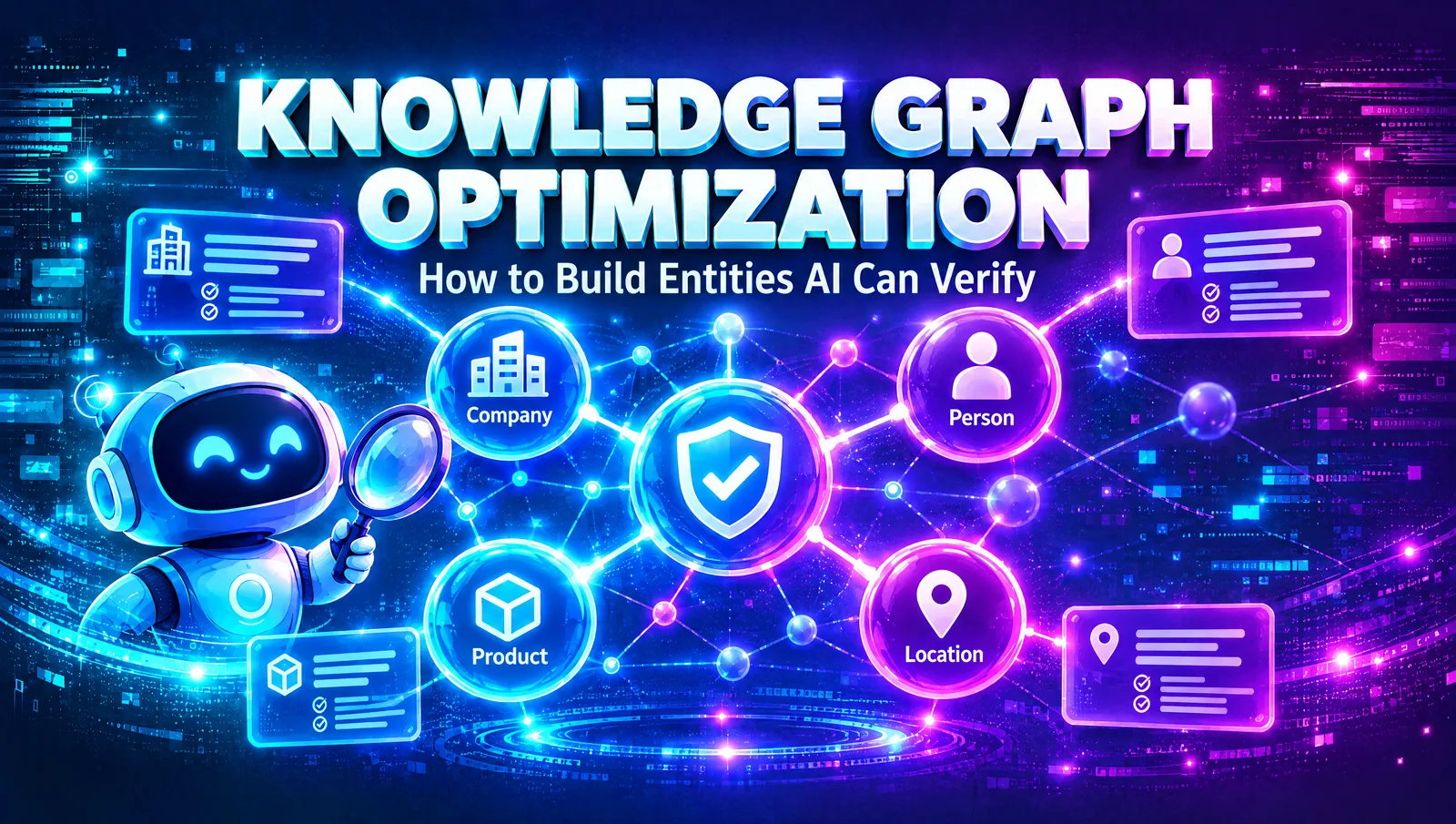
Knowledge graph optimization is the work of clarifying the identities and relationships of organizations, people, products, and locations across digital sources. It combines reliable first-party information, structured data, and relevant third-party records. The objective is for search engines and AI assistants to find consistent answers about who a business is and what it offers.
Google introduced its Knowledge Graph in May 2012, describing a shift toward understanding “things, not strings.” A knowledge graph represents subjects and relationships, rather than treating every name as an isolated phrase.
What Is an Entity in SEO?
An entity is a distinct person, organization, place, product, or concept. Its name is only one attribute. Other attributes, such as an official website, employer, publisher, and location, help separate it from similarly named subjects.
Consider a fictional software company, Cedarline Systems, and its product, Cedarline Forecast. A graph might represent Cedarline Systems publishes Cedarline Forecast. It might also link a founder to the company or identify the product's supported industry. Each relationship needs to be factually correct.
The simple structure is subject, relationship, object. When a product changes publishers after an acquisition, the current relationship may change without erasing its history.
GEO vs. Knowledge Graph Optimization: Where Do They Meet?
Generative engine optimization (GEO) studies how brands and sources appear in AI-generated answers. Entity-based SEO addresses identity and subject relationships. Traditional SEO supports discoverability and useful pages. They overlap when an assistant describes a company using information from several websites.
| Discipline | Main focus | Typical work | Evidence to review |
|---|---|---|---|
| Traditional SEO | Discoverable, relevant pages | Technical health, content, internal links | Search visibility and qualified visits |
| Entity and knowledge graph SEO | Correctly identified subjects | Entity pages, JSON-LD, source reconciliation | Identity consistency and factual errors |
| GEO marketing | Representation in generated answers | Prompt monitoring, citation review, content corrections | Mentions, sources, accuracy, referrals |
For knowledge graph SEO, the practical test is whether a buyer can identify the right company and product across sources.
Give Each Brand, Product, and Person a Reliable Home
A homepage often leaves product ownership, subsidiaries, and former brands unexplained. Knowledge graph optimization needs a maintained home page for each significant subject and clear links between them.
Start with an approved fact register. Include public and registered names, former names, official URLs, publishers, leadership, and locations. Record effective dates and the responsible owner.
A fact register should answer questions the sales and legal teams already receive. Who provides support? Which organization signs the agreement? Does an old product name still refer to the current offering? Those are details a buyer may encounter in both search results and contracts.
For Cedarline Forecast, the product page can name its publisher and acquisition date. The About page identifies the operating business. Historic names remain where they clarify older records.
This is where entity-based SEO differs from keyword SEO. Another article mentioning a brand name won't repair an incorrect identity record. Marketing needs an agreed source of truth and a way to maintain it.
How to Carry Out an Entity SEO Audit
An entity SEO audit compares approved facts with website and external descriptions. Knowledge graph optimization needs a prioritized correction list, with sources and owners. Start with the company, main products, key people, and real locations.
- Inventory the subjects. List companies, product lines, key people, and locations. Record former names when they remain publicly visible.
- Choose entity home URLs. Give each major subject a stable page that clearly identifies it and its relationships.
- Inspect search and AI descriptions. Look for outdated names, wrong products, mistaken categories, and similarly named companies.
- Create approved fact sheets. Attach evidence and an owner to each fact before changing the website or structured data.
- Update visible pages. Correct the About page, product descriptions, executive biographies, and relevant support documentation.
- Connect the schema nodes. Apply stable identifiers and properties that match those visible claims.
- Request outside corrections. Contact relevant publishers and directory owners with a factual explanation and supporting link.
- Track unresolved discrepancies. Record the source, date, owner, requested change, and observed result.
For local entity SEO, include genuine business locations and eligible Google Business Profiles. Distinguish a service area from a physical office. Duplicate listings and invented addresses create problems for customers as well as search systems.
A crawler finds technical problems, a validator inspects schema, and AI monitoring samples assistant descriptions. Compare entity SEO tools by their actual functions before purchasing.
How Structured Data Connects the Entities on Your Website
Structured data describes facts about a page and its subjects in a machine-readable format. Schema.org provides a shared vocabulary, and JSON-LD is a common implementation method. Google's Organization structured data guidance explains how company details can help distinguish one organization from another in Search.
A stable @id identifies a subject across related nodes. In knowledge graph optimization, preserve that identifier across pages and ordinary updates.
The following simplified example describes a fictional company and the software it publishes:
{ "@context": "https://schema.org", "@graph": [ { "@type": "Organization", "@id": "https://example.com/#organization", "name": "Cedarline Systems", "url": "https://example.com/" }, { "@type": "SoftwareApplication", "@id": "https://example.com/forecast/#software", "name": "Cedarline Forecast", "publisher": { "@id": "https://example.com/#organization" } } ] }
The publisher property describes who publishes the product, not every ownership right. Replace the fictional URLs with verified information before deployment.
What Does sameAs Add?
The Schema.org sameAs property identifies a reference URL describing the same entity. A genuine corporate profile or qualifying Wikidata item may help. A partner's website or a news story merely mentioning your product is not automatically the same entity.
Use @id to connect your own graph nodes and sameAs for suitable identity references. Make sure the referenced pages describe the correct business, not another organization with a similar name.
Which Schema Types Should a B2B Brand Use?
Choose properties according to the actual subject. A B2B software vendor may need company, product, and author information, while a multi-location service business has different requirements. The Sorn.ai guide to schema types gives more examples by page purpose.
| Type | Appropriate use | Relationship to check | Typical error |
|---|---|---|---|
Organization |
Official company identity | Name, URL, logo, parent organization | Confusing a brand with its legal operator |
Person |
Founder or expert biography | Current affiliation and role | Former position shown as current |
WebSite / WebPage |
Site and page identification | Publisher and subject | Different organization IDs in templates |
SoftwareApplication / Product |
Actual software or product | Publisher, brand, real offers | Unsupported capabilities or ratings |
Service |
A service the company provides | Provider and scope | Marking informational topics as services |
LocalBusiness |
Genuine eligible locations | Address and business identity | Creating fictional local branches |
Article |
Editorial material | Author and publisher | Inaccurate or missing author information |
Validate the markup and inspect the published page. Rich Results Test and Schema Markup Validator serve different purposes. Valid syntax cannot rescue outdated product facts.
Connect Your Brand Across Relevant Outside Sources
A buyer may find your business in a directory, an industry article, or a founder's profile. Knowledge graph optimization also requires checking those external sources for contradictory identities.
Prioritize relevant public records and industry sources. Distinguish a founder's current role from former employment, and date historical product relationships.
Wikidata's notability policy governs which items belong there. Don't create promotional entries to collect entity identifiers. A company without a Wikidata record can still maintain accurate official profiles and published business information.
Where relevant, use legitimate government business records and accurate classifications. For a U.S. business, the Census Bureau's NAICS reference can help verify the appropriate industry description. It is not a shortcut to obtaining a particular Google category.
Independent publishers may retain accurate historical details or different wording. Request specific factual corrections, not identical descriptions across every website.
What Google Knowledge Panels Can Tell You
Google's Knowledge Graph represents entities and relationships. A Knowledge Panel is one display that may appear when Google has information about a recognized subject. Knowledge graph optimization includes inspecting these panels for outdated logos, wrong profiles, or mistaken executive affiliations.
A company or person can verify certain existing panels through Google's claiming process. Search for the subject and look for Claim this knowledge panel. Some panels are not claimable, while eligible local businesses use their Business Profile controls.
Verification permits feedback, not full editing access. For Google entity SEO, investigate any former executives or inaccurate company profiles shown on the panel.
For founders, connect current biographies and real speaking records to verifiable professional expertise. Use appropriate Person data and check public accuracy beyond the panel.
The Knowledge Graph Search API can be used to investigate matched entities. Google describes the API as read-only and directs new integrations toward Cloud Enterprise Knowledge Graph. It does not allow a marketer to insert a new company record or edit an existing one.
Treat a Knowledge Panel error as a source-investigation task. Record the wrong fact and the evidence needed to correct it. The next useful measure is whether the public information becomes more accurate.
How to Repair a Confused or Outdated Brand Entity
Brand confusion may merge similarly named firms, preserve former product publishers, or misidentify executives. Knowledge graph optimization separates the controllable website facts from third-party corrections.
Imagine an unrelated company called Cedarline Freight appearing alongside Cedarline Systems in a directory. Both use the word Cedarline, but only one publishes Cedarline Forecast. The software company's official description should make its industry, domain, and product relationships unmistakable. If an AI answer cites the freight company's profile, marketing can contact the directory with the correct source, rather than rewriting every software page.
| What appears wrong | Likely source of confusion | First useful action | Responsible team |
|---|---|---|---|
| Two businesses treated as one | Similar names and incomplete identity details | Clarify official URLs, sectors, and profiles | Brand and web |
| Former product publisher shown | Old directories or documentation | Publish the verified current relationship | Product and legal |
| Wrong executive affiliation | Undated biographies or old coverage | Correct the current bio and dated records | Communications |
| Duplicate schema nodes | CMS templates or overlapping plugins | Reconcile @id references |
Engineering and SEO |
| Incorrect business category | Inconsistent service descriptions | Verify category against actual operations | Marketing and operations |
| Closed location remains active | Outdated local records | Update official and eligible local profiles | Operations |
Record the disputed claim, source URL, supporting evidence, owner, and status. Preserve historical facts and follow up on unresolved requests through normal editorial channels.
Not every conflicting description is an error. A former company name can be appropriate in an article about an acquisition. The record becomes misleading when it describes the old relationship as current.
Enterprise Knowledge Graph Optimization: Prevent Entity Drift
On large websites, identity drift often comes from templates and separate publishing systems. One region shows the new company name while another generates the former publisher.
Enterprise knowledge graph optimization requires approved names, stable identifiers, and relationships in a shared registry. Templates can reference it, with dated historical records retained where useful.
Test representative pages after a CMS release, acquisition, product launch, or major rebrand. Checks should catch missing nodes, duplicate IDs, contradictory publishers, and stale leadership details. An audit log should identify who approved the facts, who deployed the change, and who confirmed the public result.
Fix the data feeding the templates before editing hundreds of pages by hand. A sitewide schema deployment can spread the same mistake faster than a human could. The content and structured data should draw from compatible records.
What Better Entity Clarity Does for B2B Buyers
Entity-based SEO for LLMs begins with facts buyers already need. Procurement checks the contracting entity, IT checks the publisher, and sales identifies the support provider.
Knowledge graph optimization gives these teams one account of the relationship. Marketing can then flag external sources that contradict the approved records.
For AI search, monitor questions specific to those relationships rather than only broad category keywords. The Sorn.ai guide to GEO for SaaS covers the wider vendor-selection process. This article addresses the underlying identity records that buyers may rely on.
If an assistant repeatedly names the wrong publisher, ask the product owner to confirm the approved relationship. Then make the official material unambiguous and examine any cited outside source. That gives marketing a concrete task instead of another generalized request for more authority.
Monitor Entity Accuracy With Sorn.ai
After website changes, assistants may still repeat old information. Sorn.ai's AI visibility platform monitors descriptions, mentions, citations, and competing brands across ChatGPT, Gemini, Perplexity, and Claude.
A software team could test questions such as:
- Who publishes Cedarline Forecast?
- Is Cedarline Forecast part of Cedarline Systems?
- Which products does Cedarline Systems offer?
- Does the former publisher still provide support?
For each response, note the assistant, question, date, cited sources, and relationship described. Then compare the answer with the approved fact register. If the answer is wrong, assign the underlying correction to product, web, communications, or an external publisher.
The Sorn.ai approach to LLM brand monitoring supports consistent reviews. Every disputed answer needs a source and an owner.
A repeated wrong publisher name might lead product marketing to update official documentation and communications to request an outside correction. The next monitoring review can show which assistant responses still use the old relationship. Those findings also tell sales which public records need clarification before a procurement conversation.
Google's Generative AI performance report supplies a separate view of linked-page impressions in AI Overviews and AI Mode. Sorn.ai's four-assistant monitoring does not replace that Google reporting. Review both alongside identifiable website referrals and relevant customer enquiries.
To review your own brand relationships, schedule a Sorn.ai demo using questions that buyers might ask.
When Do You Need Entity SEO Services or a Specialist?
In-house teams may maintain their own fact register and markup. Acquisitions, complex websites, and multiple publishing systems may require specialist implementation.
An entity SEO agency might inventory records, implement schema, repair CMS templates, or manage factual outreach. Entity SEO services need a clear deliverable for every affected site or record. Ask who approves relationships, who makes changes, and how quality assurance works.
Sorn.ai is an AI visibility and monitoring platform. It can surface observations across supported assistants, while implementation and external corrections require appropriate owners. Its team and product background explain the monitoring offering. The comparison of LLM visibility tools can help define what evidence to request from software vendors.
For a small organization, begin with the official company and product pages. For enterprise portfolios, a data-governance and deployment plan may be the more substantial purchase. Don't confuse tracking a disputed claim with correcting its source.
A Practical 90-Day Entity Cleanup Plan
Days 1 to 30: Approve the entity inventory, identify current names and relationships, and record the most consequential public conflicts. Assign a clear owner to each disputed fact.
Days 31 to 60: Update official pages and structured data, then request documented corrections from relevant outside sources. Validate representative CMS templates before wider release.
Days 61 to 90: Review unresolved requests, repeat comparable assistant questions, and check whether customers still encounter the same confusion. Use the remaining issues to prioritize the next work cycle.
The schedule is an internal delivery plan. External publishers, Knowledge Panels, and assistant responses have their own update cycles.
---
Frequently Asked Questions About Knowledge Graph Optimization
Does Schema Markup Help SEO?
Yes. Structured data helps search engines interpret subjects and can support certain Search features when eligible. Google doesn't require special schema for AI Overviews or AI Mode. Markup should accurately describe the published information and meet applicable guidelines.
How Do You Claim a Google Knowledge Panel?
Look for Claim this knowledge panel on an existing panel and complete Google's verification process. The option isn't available for every subject. Verified representatives can submit feedback, but cannot directly rewrite all the information Google displays.
How Do You Correct a Wrong Knowledge Panel?
Use the panel's feedback controls and provide clear supporting evidence. Update the official pages and relevant outside profiles that carry the inaccurate fact. Preserve historically correct information while clarifying present-tense roles and relationships.
Is a Wikipedia Page Necessary?
No. A business can have accurate search and AI descriptions without a Wikipedia article. Wikipedia and Wikidata follow their own eligibility rules and editorial standards. Create or update entries only when the subject qualifies and the changes comply with those policies.
What Does Entity Authority Mean in SEO?
Entity authority is an informal description of how credibly and consistently an entity is represented for relevant topics. There is no single official score shared by Google and AI assistants. Examine the quality of the supporting records and whether important claims are accurate.
Can Schema Markup Be Automated?
Yes. CMS extensions, schema platforms, and custom pipelines can generate structured data from approved records. Automation still requires stable identifiers, correct relationships, and regular testing. An incorrect field in the source system can spread across every page using it.
How Long Does Knowledge Graph Optimization Take?
A company can plan its own content and schema changes, but independent publishers and search systems control their update schedules. Prioritize corrections that affect customers and check them periodically. No fixed timetable applies to Knowledge Panels or AI citations.
What Do Knowledge Graph Optimization Services Cost?
Pricing varies with the number of entities, complexity of the websites, external corrections, and monitoring needs. A single-company review is different from a multi-brand migration. Compare the implementation scope and software subscription separately before requesting a quote.
The Next Buyer Should Find One Consistent Company
The next prospect who questions Cedarline Forecast's publisher should receive one reliable product page, not an email chain explaining the acquisition. That page can name the current publisher, date the transition, and link to the operating company. The sales conversation can move on to whether the software fits.
To find where the old description still circulates, test those ownership questions with Sorn.ai. The result to act on is the source that still needs correcting.