Zero-Click Search: What It Means for Traffic and How to Adapt
Your best-performing explainer still ranks. The team updated it recently, and Google continues to show it for the right questions. Yet fewer people are visiting. In the next marketing meeting, someone will ask whether the content budget is still justified.
It's a reasonable concern. A person researching subscription billing might get the definition from an AI Overview, then close the tab. Another might remember the vendor's name and return later to check an integration. Those are very different outcomes, even though neither produces a click on the original search.
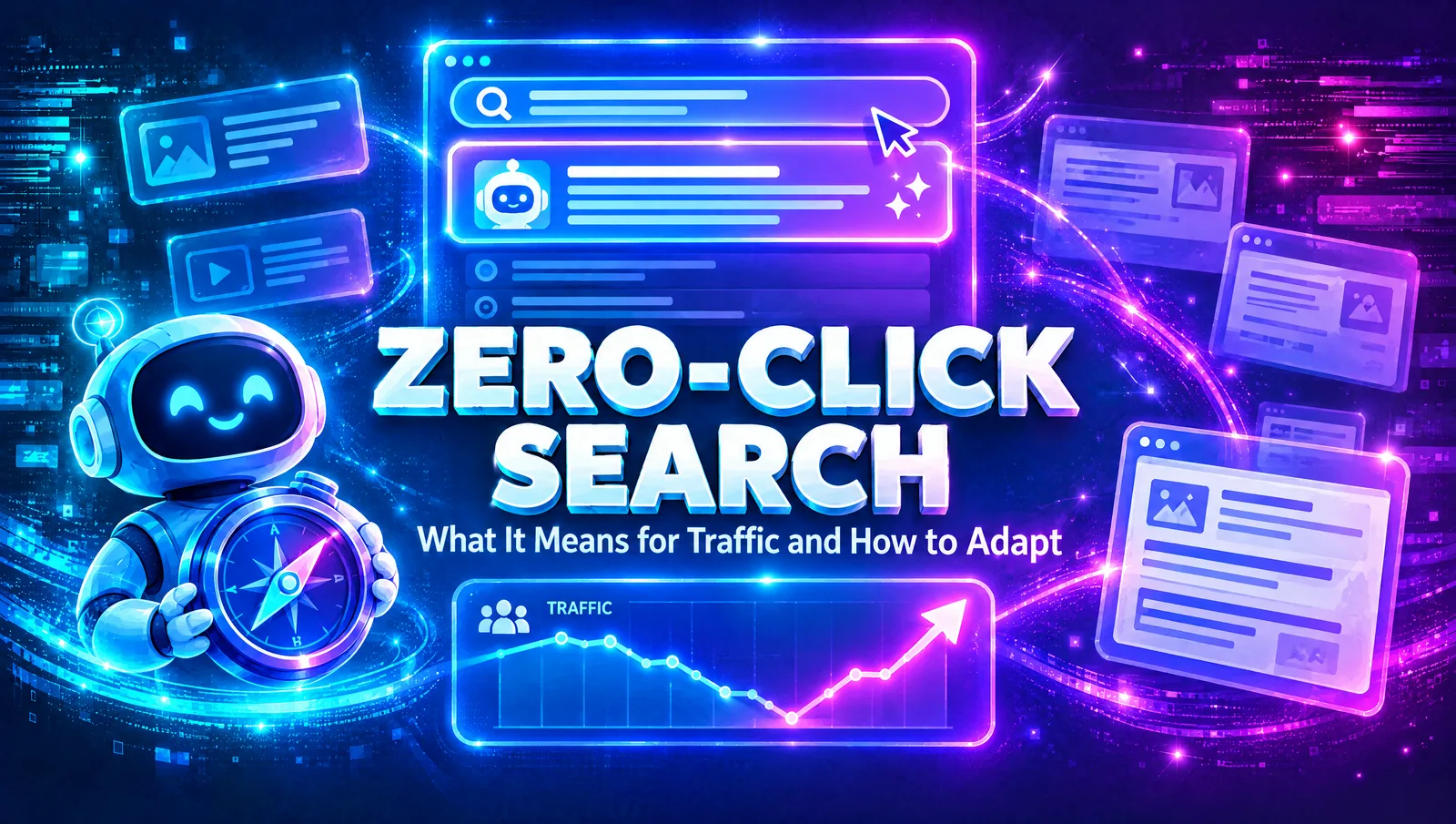
A zero click search means the search ends without a click to a result. For marketers, the challenge is deciding where a visit still matters, what deserves to be visible without one, and how to connect later customer activity to a defensible business case.
What Is Zero-Click Search, and Why Does It Happen?
A zero click search ends without the user clicking a result. The answer may appear directly on Google, or the person may refine the query or abandon the search. Zero click searches are a behavioral measure, not proof that a particular brand was seen or that AI provided the answer.
Many zero click searches predate generative AI. Featured snippets answer definitions, knowledge panels show company details, and local results offer calls or directions. AI Overviews and AI Mode add generated summaries and linked sources to that range of experiences.
Is It Really More Than 60% of Searches?
SparkToro's June 2026 research estimated that 68.01% of US Google searches ended without a click during January through April 2026. The estimate used Similarweb desktop and mobile browser-panel data, with assumptions about device weighting and session boundaries. It does not measure all Google activity or isolate AI as the cause.
The research also reports a different estimate for 2024, but panels and measurement choices have changed over time. Treat the figures as evidence of broad search behavior, not an exact year-over-year traffic loss for your site.
A separate Pew Research Center study published in July 2025 found traditional-result clicks in 8% of visits with an AI summary, versus 15% without one. Users clicked a source link inside a summary in just 1% of those visits. The findings came from observed Google searches, not AI assistant purchases or your customer's journey.
Different search features change what customers need from the next step:
| Search experience | What the person may get without visiting | What may still earn a visit |
|---|---|---|
| Featured snippet | A definition or short process | Worked examples, detailed instructions, tools |
| AI Overview or AI Mode | A synthesized explanation or comparison | Original evidence, implementation detail, product evaluation |
| Knowledge panel | Basic business information | Services, verified capabilities, a direct enquiry |
| Local result | Hours, directions, phone number | Booking, pricing, a complex service decision |
| Product listing | Price, availability, basic specifications | Compatibility, returns, checkout |
| Chat assistant | A vendor shortlist or answer with sources | A demo, source methodology, technical documentation |
No-click does not mean no-interest. It also does not mean every exposure has value. The difference becomes clear when you inspect the queries losing visits.
Diagnose the Traffic Decline Before Changing Content
Start with Google Search Console, not a new publishing calendar. Compare equivalent periods for impressions, clicks, click-through rate, and average position. Separate branded searches, informational questions, comparisons, and purchase-ready queries. Check seasonality, site changes, and ranking movements before blaming answer features.
Suppose a fictional invoicing platform has stable impressions for "what is invoice matching" but fewer clicks. Its integration pages still attract qualified visitors. Rewriting the integration content for a broad definition would solve the wrong problem.
Here is a useful diagnostic sequence:
- Find the affected pages. Compare search queries and landing pages, not only site-wide traffic.
- Check what changed on the results page. Look for summaries, snippets, product features, or competing pages.
- Review intent. Decide whether the person needs a basic fact or a deeper decision tool.
- Test the next step. Confirm that visitors can reach the relevant comparison, calculator, product, or consultation.
- Prioritize by commercial value. A decline in high-intent visits usually deserves attention before low-value glossary traffic.
Google's Generative AI performance report in Search Console shows linked-page impressions in AI Overviews and AI Mode. It was available worldwide from August 31, 2026. Pages, dates, countries, and devices help identify where those impressions occur.
The generative impressions are already included within Search Console's overall Web performance data. Don't add the two totals together. The dedicated report does not provide separate clicks or conversions from those AI features. Use ordinary Search reports and analytics for the visit data you can identify.
A sound zero-click search strategy starts by deciding which lost visits deserve recovery and which questions your existing pages already satisfy.
How to Adapt SEO When the Answer Appears First
Zero click SEO needs a different editorial decision for every search intent. When a query can be answered in a sentence, make the answer accurate and accessible. When a buyer needs a decision, give them evidence that a short summary cannot substitute for.
For Google, the official AI Search guidance still emphasizes established SEO practices. It doesn't require an llms.txt file, special AI-only markup, or content broken into artificial fragments. Indexing, helpful pages, accurate information, and suitable structured data remain worthwhile.
Focus zero-click search optimization on four tasks:
- Preserve discovery. Check technical accessibility, sensible internal linking, and clear titles before adding new content.
- Answer the immediate question. Write concise explanations without making readers work through promotional copy.
- Support the answer. Show original measurements, relevant qualifications, current product facts, or the research method.
- Offer a worthwhile continuation. Give someone a reason to use a tool, inspect a specification, or discuss a real purchase decision.
For an operations software vendor, a definition of stock reconciliation can be brief. The accompanying example could demonstrate a discrepancy across multiple warehouses, then lead to a downloadable audit worksheet. The useful work happens after the definition.
The relationship between AEO and SEO is especially practical here. Rankings and indexing are still measurable, while answer appearances and customer actions need different evidence. Don't sacrifice a page that converts well to chase a citation that hasn't been observed.
Which Content Formats Still Earn the Click?
For zero click search, the strongest content often contains work the user cannot finish inside an answer. A summary can describe a method; it cannot always apply that method to the visitor's accounts, inventory, or circumstances.
For B2B, useful formats include interactive cost estimators, integration matrices, migration checklists, and benchmark data with published methodology. Ecommerce customers may need compatibility tools, size guides, detailed returns, or comparisons using current product specifications. Publishers can offer reporting, searchable databases, and specialist analysis developed from original sources.
Imagine a fleet-management provider explaining vehicle downtime. The definition fits in two sentences. A calculator that compares downtime costs across different fleets takes customer-specific inputs and provides a result worth visiting for.
Offer the complete basic answer for free. Put the deeper, genuinely useful service behind the next action, not the missing definition. If you ask for an email, explain what the visitor receives and avoid imposing an unnecessary form on ordinary information.
Sorn.ai's LLM optimization checklist covers content and source clarity. Adapt those principles to real buyer needs rather than treating headings or word counts as guaranteed AI citation factors. For 2026, a strong content strategy is built on substance and maintained facts, not a promise of zero-click dominance.
Can Zero-Click Results Build Brand Awareness?
An accurate brand mention in a zero click search may be the only encounter someone has with your company that day. But a mention is not the same as recognition, and a citation doesn't establish that anyone remembered your name. The brand also doesn't own its placement on a search platform.
Use a consistent product name, clear descriptions, and legitimate public references. If an AI answer says a software product lacks a feature it already supports, investigate the official documentation and the source being cited. Accurate product facts serve buyers whether or not the correction changes the next generated answer.
A structured approach to monitoring brand descriptions helps identify repeated omissions and errors. It also allows marketers to distinguish a mention of the company from a citation linking to its website.
Branded searches, direct visits, prospect interviews, and sales feedback can provide context about awareness. Use them alongside answer monitoring, not as proof of cause and effect. This is the value of zero click marketing: understanding exposure while still making the next decision measurable.
Build a Funnel for People Who Return Later
A website can't capture an email address from an ordinary AI citation that nobody clicks. The opt-in happens when someone chooses to visit, sign up, register, or contact the brand. In zero click search, the practical opportunity is a useful next step that stays memorable after the first answer.
Consider a hypothetical SaaS buyer researching how to reconcile subscription changes mid-cycle. An assistant may explain the accounting issue and name possible vendors. Later, the buyer searches for one company and opens its billing-integration page.
That page should identify supported systems, known limitations, implementation needs, and an appropriate demonstration. A generic homepage loses the context of the original problem. The visitor may be ready to evaluate software rather than read another introductory article.
A lead-generation path can work this way:
- An answer introduces a question, product, or brand.
- A later branded search or identifiable referral brings someone to the site.
- The destination answers their next, more specific concern.
- An optional download, signup, consultation, or checkout records a real action.
- Analytics and CRM data establish what happened after arrival.
For email capture, an interactive template or original benchmark can justify a voluntary signup. A newsletter makes sense when readers need regular updates, not when a basic fact has been arbitrarily withheld.
The AEO approach to lead generation can support this progression. Earn the next interaction through usefulness. Don't assume that exposure on a third-party platform automatically creates a first-party customer relationship.
Three Ways to Protect Revenue Across Different Business Models
The economic damage from zero click search depends on how the organization makes money. A publisher loses pageview inventory; a retailer may still complete a sale after product research elsewhere. SaaS companies must decide whether fewer introductory visits are affecting qualified pipeline.
| Business model | Main pressure | Priority response | Revenue measure |
|---|---|---|---|
| Publisher | Fewer ad and affiliate pageviews | Distinctive reporting, newsletter, memberships | Subscriptions, sponsorships, licensing |
| Ecommerce | Shoppers compare without visiting | Accurate listings, useful specifications, checkout | Product sales, repeat orders, contribution margin |
| B2B and SaaS | Early-stage traffic declines | Buyer-specific tools, proof, implementation information | Qualified demos, pipeline, gross profit |
| Local services | Calls and decisions happen in results | Accurate business profile and booking information | Confirmed bookings and customers |
Publishers: Create a Reason to Return
A publisher's original reporting may be summarized without delivering the visits that funded it. Reprinting general information at higher volume may only increase the number of easily answered pages.
A specialized newsletter, searchable original dataset, or membership product can reduce reliance on single-session advertising. For a publisher, zero click content can present the main finding, while a searchable database or member report provides the deeper work.
Sponsorships and data licensing may offer additional income when there is a real paying audience. Being cited is not the same as being compensated. Measure subscriber retention, revenue per reader, and paying partners.
Ecommerce: Make Product Data Worth Trusting
A shopper comparing replacement filters might see price and availability before visiting a store. The product page still needs the exact compatible models, shipping costs, genuine reviews, and return terms. A polished category introduction won't fix an incorrect compatibility list.
Google's merchant listing structured data guidance explains how eligible Product and Offer information can support shopping displays. Merchant Center free listings can place eligible products across Google surfaces. Neither guarantees inclusion.
For ecommerce brands adapting to zero click search, align the visible page, product feed, stock status, and checkout. Add comparison help where a buyer faces a real choice. The ecommerce AEO implementation guide is relevant to product accuracy and answer-ready details. Measure purchases and margin, not exposure alone.
B2B and SaaS: Turn Research Into Evaluation
In zero click search, a buyer may never visit a site merely to learn what customer-data integration means. They might visit when they need proof that a specific platform supports their warehouse or security requirements. That is the opportunity for a credible comparison, integration document, or demo.
SaaS GEO planning around vendor selection can help prioritize prompts with purchase criteria. Qualified conversations and closed deals are the commercial events; appearances in generated shortlists are research observations.
How to Measure ROI From Zero-Click Searches
Zero click search makes attribution harder, but it does not change the definition of ROI. You cannot calculate profit from an answer that never generated an identifiable interaction. You can measure visible placement, referred visits, and recorded commercial outcomes, then investigate whether the work changed results beyond what would have happened anyway.
Start with sources that each measure a different part of the journey:
- Search Console: ordinary clicks and impressions, plus linked-page impressions from Google AI Overviews and AI Mode.
- Google Analytics 4: identifiable website sessions and key events. Its AI Assistant channel covers supported assistant referrers but excludes Google's AI Overviews and AI Mode.
- Sorn.ai: selected prompt appearances, citations, competitor mentions, and description accuracy across ChatGPT, Gemini, Perplexity, and Claude.
- CRM and sales reporting: leads, accepted opportunities, purchases, and gross profit where recorded.
The measurement table should define each denominator before anyone sees a percentage:
| Metric | Calculation or source | What it establishes |
|---|---|---|
| AI mention rate | Answers naming the brand / answers tested | Visibility within a defined sample |
| Citation rate | Answers linking to the brand / answers tested | Linked presence within the same sample |
| Google generative impressions | Dedicated Search Console report | Linked-page displays in covered Google features |
| AI-referred conversion rate | Conversions from identifiable assistant sessions / those sessions | Activity from tracked referrals |
| Branded search change | Comparable branded query trends in Search Console | Demand movement, without proof of its cause |
| Incremental ROI | (Incremental gross profit - program cost) / program cost | Financial return when incrementality is credibly estimated |
A Simple ROI Calculation With Honest Assumptions
Suppose a company spends $12,000 on new product evidence, landing pages, and AI monitoring. In a comparison period, gross profit from additional customers totals $30,000. If a sound comparison shows that all $30,000 was truly incremental, the program's ROI is 150%.
If only half the profit is incremental, the modeled ROI falls to 25%. If none of it is incremental, the program has not recovered its cost. A CRM label saying "AI-influenced" is not sufficient evidence for choosing the first scenario.
Use holdout groups, suitable before-and-after comparisons, or conservative scenarios when a controlled test isn't feasible. Keep a separate line for observed assistant mentions. The B2B comparison of LLM visibility and traditional SEO ROI is only meaningful when both use consistent lead and profit definitions.
The strongest report distinguishes measured revenue from plausible influence. Leadership can then fund what performs without assigning invented value to every citation.
How Sorn.ai Fits the Monitoring Work
Sorn.ai monitors how businesses appear in selected answers across ChatGPT, Perplexity, Gemini, and Claude. The platform reports prompt visibility, citations, competitor appearances, and factual description accuracy. It also supports experiments around prompt groups. It does not edit your site or guarantee recommendations.
For a zero-click search program, choose a stable panel of genuine buying questions. A software vendor could test integrations, security features, use cases, and alternatives. Track when the company is mentioned, which sources appear, and whether its product is described correctly.
If an assistant repeatedly misstates a supported integration, the product team can verify the documentation. If a competitor appears for a capability the brand offers, marketing can inspect whether its own material explains that capability clearly. Keep a record of updates and test comparable prompts later.
This is monitoring rather than revenue attribution. The differences among LLM visibility analysis tools matter when comparing supported assistants, sample design, and the evidence behind summary scores. Use Sorn.ai beside Search Console, analytics, and sales reporting, not as a replacement for them.
A Sorn.ai demo can begin with the buyer questions your marketing and sales teams already recognize. That produces a more useful discussion than a general promise to recover lost organic traffic.
A 90-Day Zero-Click Search Plan
Days 1-30: Identify queries losing clicks, separate them by buying intent, and review Google generative impressions. Establish baseline assistant prompts and verify that conversion reporting works.
Days 31-60: Improve the most commercially useful pages. Add original evidence, product details, or practical tools where needed. Fix weak next steps and correct inaccurate public descriptions.
Days 61-90: Repeat prompt tests, review tracked referrals, and evaluate qualified leads or purchases. Decide whether the next investment belongs in content, technical changes, products, or conversion design. Don't treat a 90-day schedule as a citation guarantee.
If the team lacks implementation capacity, an agency can help with research, page changes, or analytics. Monitoring software serves a different purpose: it supplies observations about supported AI answers. The Sorn.ai team can discuss that monitoring scope and how it complements existing reporting.
At the next budget review, bring one affected page, the search questions it answers, and the commercial action you improved. Show the actual clicks, the observed assistant appearances, and any qualified sales activity. A product comparison losing visitors while retaining demo enquiries calls for different work from a glossary losing visits without recorded leads.
Frequently Asked Questions About Zero-Click Search
Are Zero-Click Searches Bad for SEO?
They can reduce visits for questions answered directly in search. But their impact varies by intent and business model. Review rankings, demand, and conversion trends before changing a page that still serves customers well.
Do Zero-Click Results Help With Brand Awareness?
They can create exposure when a company's name appears in a relevant answer. Awareness requires more evidence than a mention alone. Branded search trends, sales conversations, and repeat visits can provide useful context without proving that an answer caused them.
Do Zero-Click Results Affect AEO Performance?
Yes. Answer engine optimization concerns how information appears in direct-answer experiences, some of which end without a visit. Track mentions and citations where observable, then report website referrals and conversion outcomes separately.
How Can You Track Traffic From AI Overviews?
Google Search Console's dedicated Generative AI report shows impressions for linked pages in AI Overviews and AI Mode. It does not break out clicks or conversions from those features. Use ordinary Search performance and analytics for identifiable visits.
Can You Get More Traffic From AI Overviews?
A detailed comparison, original tool, or product document may attract visitors who need more than a summary. There is no guaranteed citation-to-click conversion rate. Measure actual traffic and the business actions taken after someone arrives.
Which Sites Are Most Vulnerable to Zero-Click Behavior?
Publishers dependent on informational pageviews face direct pressure on advertising and affiliate revenue. Ecommerce and SaaS businesses face different risks during comparison research. Evaluate lost profit or qualified leads rather than assuming every missed visit has equal value.
Should You Hire an Agency for Zero-Click Optimization?
Consider outside implementation help when technical, content, or conversion problems exceed the team's capacity. Choose clear deliverables and verified reporting. If the main gap is knowing what AI assistants say about the brand, monitoring software may be the more relevant purchase.
Make the Next Visit Worth Someone's Time
That explainer from the opening may continue getting fewer clicks. A prospective buyer might still learn something useful from it, return for an integration detail, and become a customer. Or the missing traffic may reveal a genuine loss of demand that requires another approach.
You need to know which situation you're in. A useful zero click search program keeps the answers accurate, makes the next visit worth taking, and treats revenue claims with care.
Bring a few commercial questions to a Sorn.ai demo to see how its supported assistants describe your brand. Then use those observations alongside search and sales data to choose the next improvement.